Why Sign Size Matters More Than You Think
“I spent $1,200 on a custom sign for my storefront. Two months later, I realized people couldn’t even read it from across the street.” — this story from Reddit’s r/smallbusiness is more common than you’d expect. A sign that’s too small isn’t just wasted money — it’s a missed opportunity to bring customers through your door every single day.
Getting the size right isn’t complicated. It’s a combination of three things: how far away people need to read your sign, your storefront’s physical dimensions, and local regulations. Here’s everything you need.
The Letter Height Rule: How Far Away Can People Read Your Sign?
There’s a well-established rule of thumb in the signage industry: for every 10 feet (3 meters) of viewing distance, you need approximately 1 inch (2.5 cm) of letter height. But that’s the minimum for legibility — comfortable readability requires larger letters.
| Viewing Distance | Minimum Letter Height | Recommended Height |
|---|---|---|
| 50 ft (15 m) | 4 in (10 cm) | 6 in (15 cm) |
| 100 ft (30 m) | 6 in (15 cm) | 8-10 in (20-25 cm) |
| 200 ft (60 m) | 10 in (25 cm) | 12-15 in (30-38 cm) |
| 400 ft (120 m) | 18 in (46 cm) | 24 in (61 cm) |
Important: These measurements assume a clear, high-contrast font. Script fonts, thin strokes, or low-contrast colors (like yellow on white) effectively reduce readability by 30-50%, meaning you’ll need larger letters to compensate.
Sign Width to Storefront Width: The Golden Ratio
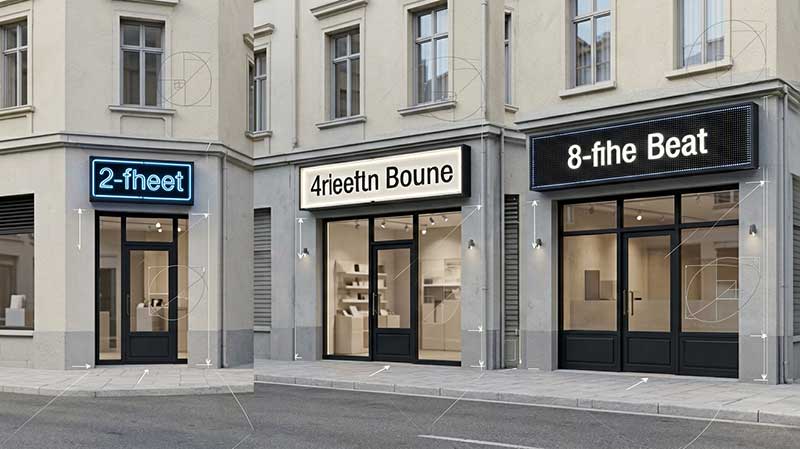
The most visually balanced storefront signs follow a 1:5 to 1:3 ratio — the sign should occupy between 20% and 33% of your storefront’s width.
For example:
- A 20-foot wide storefront → sign width of 4-7 feet
- A 30-foot wide storefront → sign width of 6-10 feet
- A 50-foot wide storefront → sign width of 10-17 feet
Signs smaller than 1:5 risk getting lost in the facade. Signs larger than 1:3 can overwhelm the architecture and may violate local code limits.
Sign Size by Storefront Type (With Examples)
| Storefront Type | Typical Width | Recommended Sign Size | Letter Height |
|---|---|---|---|
| Street-level boutique | 12-20 ft | 3-5 ft | 6-8 in |
| Restaurant / Cafe | 20-30 ft | 4-8 ft | 8-12 in |
| Strip mall unit | 15-25 ft | 3-6 ft | 6-10 in |
| Independent building | 30 ft+ | 6-12 ft | 12-24 in |
5 Common Sign Sizing Mistakes
- Designing for the computer screen, not real life — A sign that looks perfectly proportioned in your design software may be invisible at street level. Always mock it up at actual size on the building before ordering.
- Ignoring pedestrian vs. driver viewing — Pedestrians see your sign from 10-20 feet (smaller letters OK). Drivers need to read it from 100+ feet (larger letters needed). If your store targets both, design for the driver.
- Using decorative fonts at minimum size — Ornate scripts and thin serif fonts lose legibility faster than bold sans-serif at the same height. If you love a decorative font, increase the letter size by 25-30%.
- Wasting space on a logo before the business name — Your business name is the most important element. Don’t let a large logo crowd out readable text.
- Not checking local height limits — Some jurisdictions limit total sign area (e.g., 1 sq ft per linear foot of storefront). Design within code or risk having to redo the entire sign.
How Local Regulations Affect Sign Size
Before you finalize sign dimensions, check your local zoning code. Common restrictions include:
- Maximum sign area — Often calculated as a percentage of facade area (e.g., 10% of the wall surface)
- Height limits — How far the sign can project above the roofline or above grade
- Setback requirements — How far the sign must be from property lines
- Illumination restrictions — Some residential-adjacent zones limit sign brightness
Most city planning departments provide signage guidelines online. A quick search for “[your city] sign ordinance” will get you the relevant PDF. See our full permit guide for more details.
Quick Reference: Minimum Sign Size by Business Type
Not sure where to start? Here’s a practical starting point for common business types, tested across real installations:
- Coffee shop / cafe — 4-5 ft wide, 8-10 in letter height. Close pedestrian traffic needs less height; the sign needs to pop from down the block.
- Retail store — 3-6 ft wide (varies with window width), 6-8 in letter height. Window signs can be slightly smaller if supplemented with sidewalk signage.
- Restaurant — 5-8 ft wide, 10-12 in letter height. Needs to be readable from across the street and from a moving car.
- Professional office (law, real estate, dental) — 3-5 ft wide, 6-8 in letter height. Typically lower-traffic locations mean smaller signs are acceptable.
- Gym / fitness center — 6-10 ft wide, 12-18 in letter height. High visibility from distance is critical for attracting drive-by clientele.
Getting the size right is the single highest-ROI decision you’ll make for your storefront sign. A properly sized sign can increase foot traffic by 15-30%, while an undersized sign is essentially invisible advertising you pay for every month.
Browse our retail storefront signs and corporate signage galleries to see real examples of well-proportioned signs, or contact us for help choosing the right dimensions for your space.
More Storefront Sign Resources
Size is important, but so is material selection. Read our durability guide if your sign will face weather, and check where to order the right sign for your budget. Need to compare options? See our DIY vs professional breakdown.