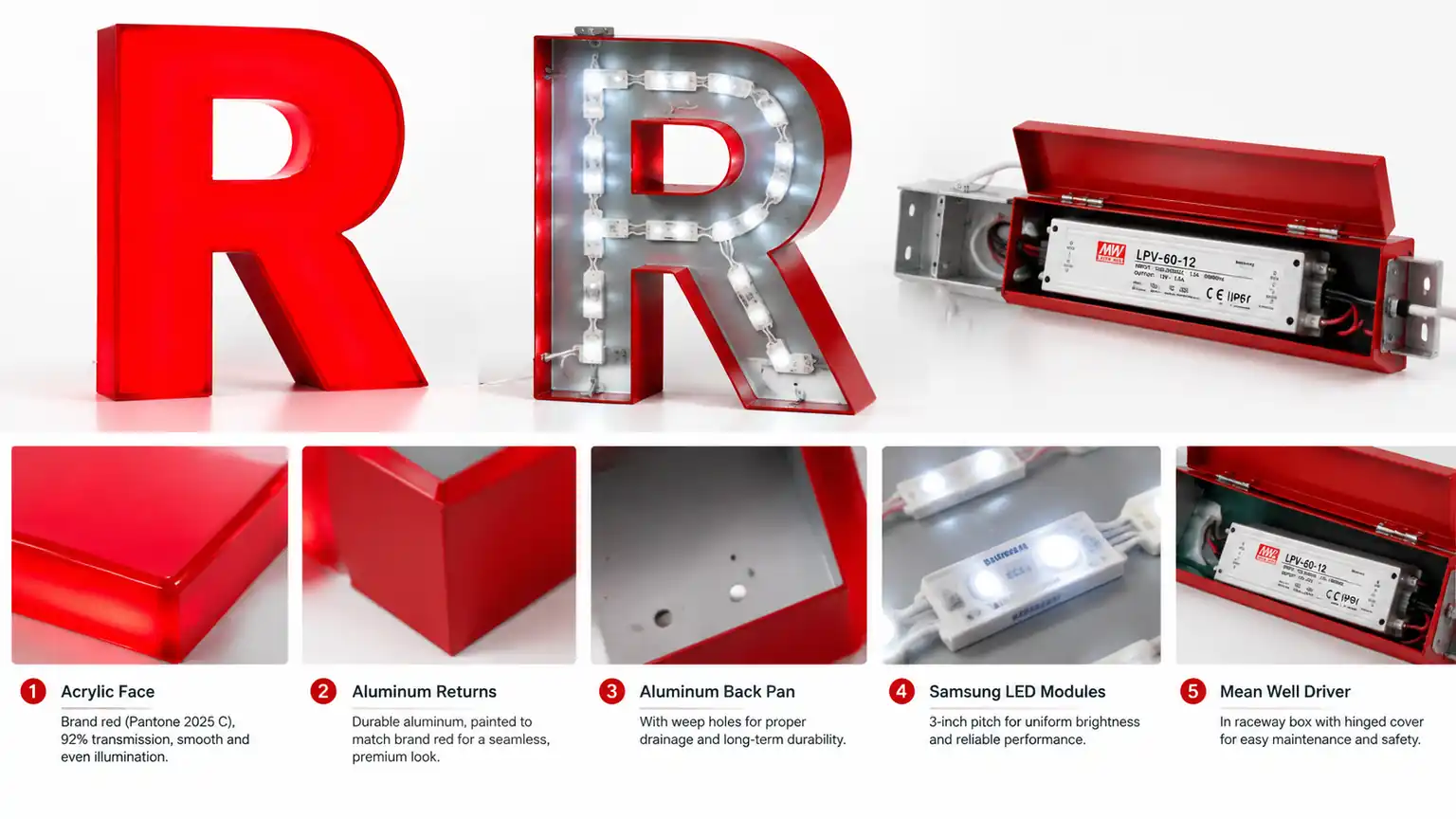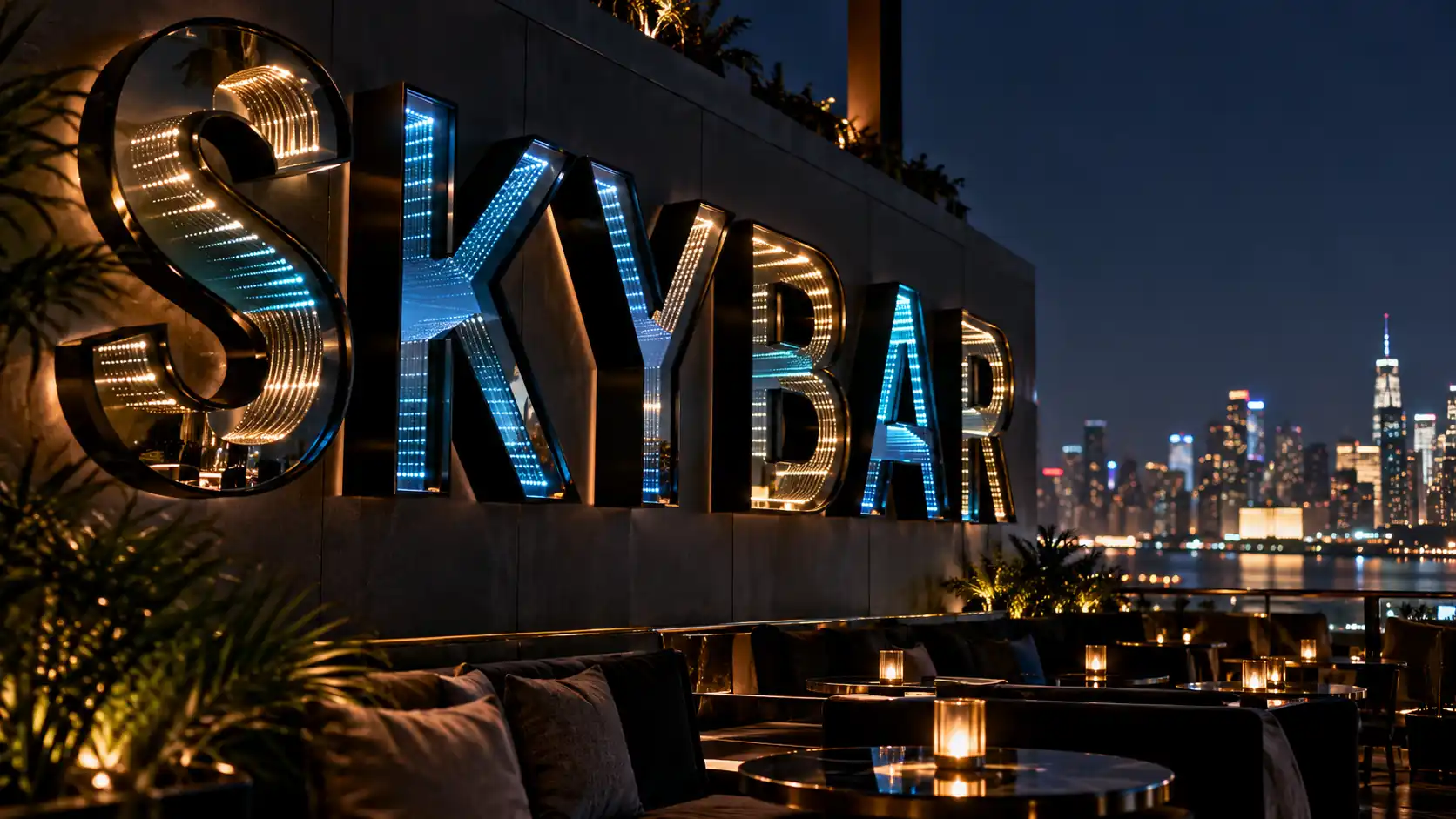
Most storefront owners who buy channel letters hit the same roadblock between “I love the mockup” and “it’s going up.” The sign is easy to fabricate. The paperwork stalls projects for weeks. Short answer: in most US cities, channel letters require at least one permit, and almost always require landlord approval. Sometimes both are the same document; sometimes they are separate approvals that must be sequenced correctly or the whole project stalls.

What a US Sign Permit Actually Covers
A sign permit is a single document issued by the local jurisdiction that approves the placement, dimensions, illumination, mounting, and material finish of a sign at a specific address. In the US the “jurisdiction” is the city or county, not a national authority. Most cities use the Uniform Sign Code (USC) or the Model Sign Ordinance (both from the Sign Council) as a starting point, then add local overrides. What it checks:
- Sign area – how many square feet of face are allowed on the building.
- Sign height and projection – top-of-sign elevation and how far a projecting sign can extend.
- Illumination – brightness, color, directional spill into residences or highways.
- Mounting and material – proof the wall, fascia, or ground frame holds the wind load; finish restrictions in historic districts.
Building vs Planning Department
Sign permits funnel through one of two windows. The building department handles signs treated as accessory structures, alongside electrical and plumbing permits. The planning department handles design-review items, especially in downtown, historic, or commercial-district overlays. Larger cities run a dedicated Sign Board; smaller counties roll sign review into general Plan Review.
Who Can Approve or Veto It
Three parties can approve or block your sign: the municipality issues the legal permit; the landlord issues the private approval; an overlay – a historic district, HOA, or commercial design commission – sits above both. Highway corridors add the state DOT; near an airport, the FAA has overlay too.
When a Permit Is Required
Every US city writes its trigger differently, but the thresholds below cover most storefronts. If any one applies, assume the permit is required.
Sign Area, Height, and Illumination Thresholds
- 2 to 12 sq ft of visible letter face – small window signs may fall under a “de minimis” rule; channel letters almost always exceed it.
- Any illuminated sign, regardless of size, in most commercial districts.
- Any projecting sign from the building face – a projecting channel letter or blade sign is essentially always permitted.
- Top-of-sign height – common limits are 10-12 ft on low-rise retail, up to 25 ft or building height in commercial districts. Projection is typically capped at 24 inches for a projecting channel letter and 6 inches for a halo-lit wall-mount gap.
- Luminous intensity capped in residential or mixed zones; directional spill must not enter a residential bedroom or a highway.
- Color – LED cool white is usually fine; neon is often restricted in historic districts. Some codes reference flicker-free driver requirements, which is exactly why LED channel letters are preferred over old neon.
- Setback – commonly 5 to 10 feet from the property line. If the fascia already extends over the sidewalk, the permit may need to retro-fit the sign into the rule.
Jurisdiction Comparison – What Varies
| Jurisdiction | Sign Height | Illumination Rule | Required Drawings | Timeline |
|---|---|---|---|---|
| New York City | 15 ft typical | Approved colors only | Sign board + structural | 2-3 weeks |
| Los Angeles | 10-15 ft | Full review | Elevation + photo | 3-6 weeks |
| San Francisco | Varies | Design review | Multi-document | 4-8 weeks |
| US Suburbs (median) | 10-20 ft | Basic | One-page diagram | 1-2 weeks |
The pattern is consistent: the more overlay districts a city carries – historic, commercial core, downtown renewal – the longer the process.
Landlord and Property Owner Approval
Most storefront buyers rent. The landlord or property manager holds a second approval independent of the city – often the harder of the two in a large retail center.
What Landlords Usually Require
- A rendering or CAD elevation showing how the channel letters will look.
- Mounting plan – through-bolted, surface-mounted, or anchored into a sign box.
- Electricity contribution – the tenant usually brings the electrical cost to the wall.
- Removal plan – restore the wall at lease end.
- Approved contractor list, if the manager maintains one.
- Insurance certificate – tenant carries liability for install and the completed sign.
Order of Operations That Works
- Get landlord approval before you order fabrication.
- Apply for the city sign permit with a compliant drawing set.
- Once the permit is stamped, issue the fabrication order.
- Bring in a licensed electrician for any permanent wiring change.
- Schedule the final inspection after install, before the sign is energized.
Electrical Permits for Illuminated Signs
A permanently wired LED channel letter sign is, in most US jurisdictions, an electrical work item independent of the sign permit. The sign permit approves the sign; the electrical permit approves the permanent power connection. Channel letters ship with low-voltage wiring terminated to a transformer; a licensed electrician connects it to a hardwired 120V source on the wall and files the electrical permit. For low-voltage-only channel letters some jurisdictions waive the permit – assume required until told otherwise.
This is one of the reasons buying directly from a manufacturer like Y SIGNS’ Front and Back Lit Sign works better than a fully turnkey local contractor – the manufacturer delivers the letter assembly ready for a local electrician to handle the code portion. You keep the factory’s fabrication cost advantage while the electrical work stays in the jurisdiction’s lane.
Timeline and Cost of the Permit Process
Typical Timeline
- Landlord approval – 1 week to 2 months.
- City sign permit – 1 to 8 weeks, based on jurisdiction and drawing completeness.
- Electrical permit – 3 days to 2 weeks.
- Final inspection – 1 to 2 weeks after installation.
Realistic Cost Breakdown
| Line Item | Typical Cost (USD) |
|---|---|
| City sign permit fee | $150 – $800 |
| Architect or engineer drawings | $500 – $2,000 |
| Electrical permit + rough-in | $1,000 – $4,500 |
| Installation labor | $1,200 – $3,000 |
Fabrication dominates any permit or electrical cost, so the goal is not to avoid the permit – it is to avoid rework. A $600 redesign because the city rejected the letter depth costs more than the permit itself.
How Y SIGNS Supports the Permit Application
Every project we quote includes the documentation US plan reviewers ask for: dimensioned drawings in PDF and DXF, an elevation diagram showing the back-to-wall gap for a halo-lit sign, a weight and load specification for structural sign-off, a wiring diagram for your local electrician, and a photorealistic mockup for the landlord. If your wall is a specific substrate, our guide on backlit letters on brick, stucco, or glass covers what to specify for each.
For buyers choosing between backlit and face-lit channel letters, the paperwork is similar, but backlit and halo-lit signs attract more attention on illumination review because of light spill. Our backlit channel letters cost guide covers fabrication pricing. Our Halo-Lit Letters line is engineered so the halo gap matches the most common code-accepted spacing of 1.5 to 2.5 inches. Effect styles like Infinity Mirror Letters and Spectrum Glow Letters ship with the same permit-ready package.
Code Compliance Support
We do not issue permits and we do not guarantee code acceptance – that decision belongs to the local jurisdiction. What we do is prepare the drawing set so the reviewer does not have to guess. Send us photos of the storefront and any restrictions you have seen; we will recommend letter depth, back-to-wall spacing, and any illumination limits that keep the drawing in the accepted envelope.
What Buyers Should Do Before Ordering
- Confirm the jurisdiction – the city or county building department.
- Ask the landlord for approval and get it in writing before you quote the fabrication.
- Check for overlays – historic district, homeowners association, commercial design overlay.
- Get the drawing set from the manufacturer before you submit the permit, not after.
- Book the electrician early – the electrical schedule is often the constraint.
- Keep a 6-8 week buffer between mockup approval and the date you want the sign live.
FAQ
How long does a US sign permit take for channel letters?
Typically 2 to 6 weeks at the city level, plus 1 to 8 weeks for landlord approval. Larger cities with a dedicated Sign Board review – NYC, San Francisco, some commercial-core overlays – run longer. The most common delay is the landlord, not the city.
Can I skip the permit for a small sign?
In most US cities, no. Small unilluminated window signs may fall under a “de minimis” rule, but any permanently wired channel letter sign – even under 5 square feet – almost always requires a permit. Skip it and the fine is typically 1 to 3 times the permit fee, plus the sign comes down.
Does Y SIGNS provide the drawings the city needs?
Yes. Every quote includes dimensioned PDF and DXF drawings, an elevation diagram, a wiring diagram, and a weight specification – the standard set US plan reviewers ask for. We do not guarantee code acceptance, but the drawings are prepared for review without extra back-and-forth.
What is different for a landlord-run sign vs an owner-occupied building?
Owner-occupied buildings only need the city permit. Landlord-run buildings need both, usually in that order. The landlord approval is private – not filed anywhere – but without it the landlord can stop the project at any point. If you are still deciding on the effect style, the same permit-ready package is available across the full industries catalog, so you can shop the effect first and confirm the landlord is on board before committing to fabrication.