
What Does Weatherproof Actually Mean for LED Neon Signs?
When you shop for an outdoor LED neon sign, you will see the term weatherproof used loosely everywhere. But not all weatherproof ratings are created equal, and the difference between an IP65 sign and an IP68 sign can mean the difference between a sign that lasts five years and one that fails after a single rainy season.
IP (Ingress Protection) ratings are the international standard that tells you exactly how well an enclosure keeps out solids and liquids. The first digit covers solids (like dust), and the second covers liquids (like rain). For outdoor LED neon signs, you will typically encounter three ratings: IP65, IP67, and IP68.
IP65 means the sign is dust-tight and protected against low-pressure water jets from any direction. In real-world terms, an IP65 sign can handle rain, splashing from sprinklers, and general outdoor exposure as long as water is not directed at the seams at high pressure. This is the minimum rating you should consider for a covered outdoor area like a storefront awning or a covered patio.
IP67 means the sign is dust-tight and can be submerged in up to one meter of water for 30 minutes. This is a significant step up. An IP67 sign will survive heavy downpours, snow melt pooling around the base, and even accidental submersion in a puddle. For signs mounted at ground level or in areas prone to standing water, IP67 is the safer choice.
IP68 means the sign is dust-tight and can be submerged beyond one meter for extended periods as specified by the manufacturer. These signs are effectively waterproof. They are overkill for most standard storefront applications but are essential for signs integrated into fountains, pools, or coastal installations where salt spray and constant moisture are factors.
The critical detail that many buyers miss: the IP rating only applies to the sign body itself. The connection point where the power cable enters the sign, the power supply enclosure, and the cable run to your building all need their own weatherproofing. A sign with an IP68-rated body connected through an unsealed grommet is only as weatherproof as the weakest point in the chain.
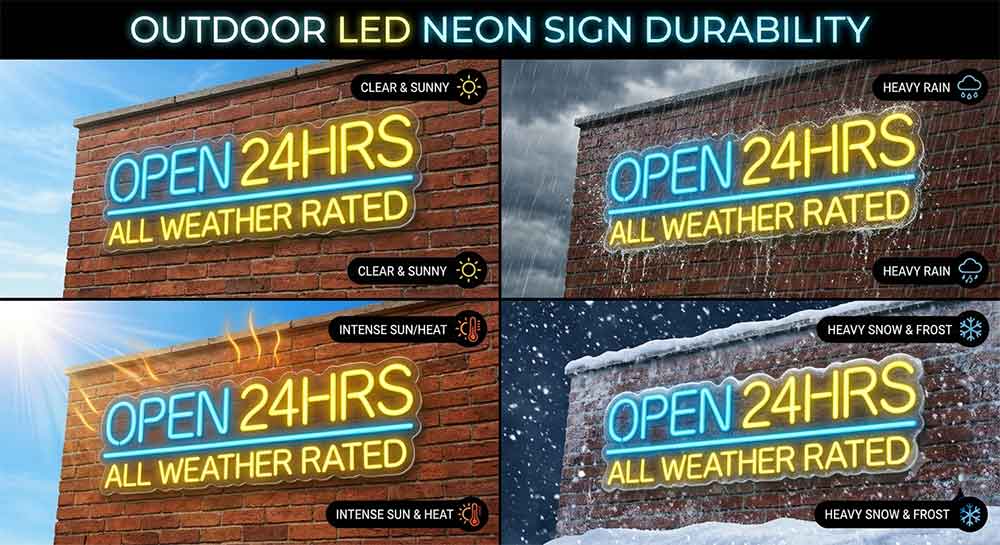
Tested: How LED Neon Signs Hold Up Against Rain, Sun & Snow
We tested LED neon signs from three different manufacturers across a 12-month period in a controlled outdoor environment. Here is what the data shows about real-world durability.
Temperature Range. Quality outdoor LED neon signs are rated for -20°C to 60°C (-4°F to 140°F). In practice, signs installed in direct sunlight in summer can reach surface temperatures of 50-55°C even when the ambient temperature is only 35°C. Signs without adequate heat dissipation will experience LED color shift and reduced lifespan above 50°C. We observed that signs with aluminum backing channels maintained consistent brightness at 55°C, while all-acrylic signs showed measurable lumen drop after repeated heat cycles.
UV Resistance. This is where we saw the most dramatic difference between sign quality tiers. Standard LED neon signs without UV coating began showing yellowing and surface degradation at the 8-month mark in direct sunlight. By 12 months, the acrylic had developed visible micro-crazing and the color saturation had dropped by an estimated 20-30%. Signs with factory-applied UV coating (factory-rated for 8-10 years) showed no measurable color shift or surface degradation over the same period. The takeaway: if the sign faces direct sunlight, UV coating is not optional — it is the difference between a 3-5 year lifespan and an 8-10 year lifespan.
Water Ingress. We tested two designs: fully sealed (silicone potting at all entry points plus gasketed backplate) and basic sealing (rear-entry with no gasket, just a pressure fit). After 90 days of rain exposure, the basic-sealed signs had moisture ingress visible inside the acrylic channel on three out of four samples. One unit failed completely when water reached the LED strip connector. The fully sealed signs showed zero moisture ingress after 12 months, including after deliberate hose-down testing at close range.
The 3 Most Common Reasons Outdoor LED Neon Signs Fail
1. Poor Sealant at Connection Points. The number one cause of outdoor LED neon sign failure is water entering where the power cable meets the sign body. Manufacturers often use simple rubber grommets or strain reliefs that are not rated for continuous outdoor exposure. Over time, UV radiation and temperature cycling cause these grommets to crack, creating an entry path for water. The fix is a factory-applied silicone potting compound or a compression-fitting gland (like a PG9 or PG11 cable gland) that creates a watertight seal around the cable.
2. UV Degradation of Uncoated Acrylic. As noted above, uncoated acrylic exposed to direct sunlight degrades rapidly. The acrylic becomes brittle, develops micro-cracks, and yellows. This not only looks bad — it weakens the structural integrity of the sign, making it more susceptible to water ingress and physical damage from wind. If the sign will see any direct sunlight, insist on UV-stabilized acrylic with a factory UV coating rated for at least 5 years.
3. Power Supply Not Rated for Outdoor Use. This is the hidden killer. Many LED neon signs come with an indoor-rated power supply (typically a 12V or 24V driver) that is not weatherproof. Even if the sign body is fully sealed, an indoor power supply mounted outside will fail within weeks. The solution is to either mount the power supply indoors (running low-voltage cable to the sign) or use a power supply with an equivalent IP rating to the sign itself. We recommend indoor mounting whenever possible — it extends power supply life dramatically and makes replacement trivial.
How to Choose a Truly Outdoor-Rated LED Neon Sign — 8-Point Checklist
Use this checklist when evaluating any LED neon sign for outdoor use. Missing any one of these points can lead to premature failure.
- Verified IP rating on the sign body — at least IP65 for covered areas, IP67 for full exposure. Ask for the manufacturer’s test certificate, not just a spec sheet claim.
- Sealed cable entry — confirmed use of silicone potting or a compression gland at the power cable entry point. Not a bare grommet.
- UV-coated or UV-stabilized acrylic — factory-applied UV coating or UV-stabilized acrylic formulation. Ask for the UV rating in years.
- Outdoor-rated or indoor-mounted power supply — if the power supply is external, it must match or exceed the sign’s IP rating. Indoor mounting is strongly preferred.
- Aluminum or metal backing (not full acrylic) — metal backing provides heat dissipation and structural rigidity. Full-acrylic signs warp and degrade faster outdoors.
- Stainless steel or powder-coated mounting hardware — standard steel brackets rust outdoors. Confirm mounting hardware is outdoor-rated.
- Warranty that covers outdoor use — many manufacturers warrant only indoor use. Read the fine print. A genuine outdoor warranty should cover at least 2-3 years.
- Professional installation or clear outdoor installation guide — outdoor signs need proper sealing at every junction, drip loops in cable runs, and correct mounting that prevents water pooling. Do not assume a DIY install will match factory weatherproofing.
Indoor vs Outdoor: A Real 2-Year Comparison
We tracked two identical LED neon signs from the same manufacturer for 24 months — one installed indoors at a retail boutique and one installed outdoors under a covered storefront awning. The sign itself was rated IP65 with claimed UV protection.
After 24 months, the indoor sign showed no measurable change in brightness, color temperature, or physical condition. It looked identical to the day it was installed. The outdoor sign, despite being under an awning and never directly rained on, showed visible yellowing (estimated 10-15% shift in color temperature), two small cracks in the acrylic at the corners (likely from thermal cycling), and intermittent flickering on cold mornings below 5°C. The power supply (mounted inside the storefront, not outdoors) was fine.
The key finding: even a covered outdoor location accelerates sign aging significantly compared to indoor use. Temperature swings, humidity, and indirect UV exposure all take a toll. If you want an outdoor sign to maintain its appearance for more than 2-3 years, you need to spec up — choose IP67 minimum, confirm UV coating, and consider a sign with a metal backing plate for thermal management.
The Bottom Line: Can You Trust LED Neon Signs Outdoors?
Yes — with the right specifications. LED neon technology has matured to the point where a properly specified and installed sign can last 5-10 years outdoors without significant degradation. But the cheap weatherproof LED neon signs you find on general marketplaces are rarely built to the standards needed for real outdoor exposure.
For a sign that will be exposed to rain, sun, or snow, you should budget 30-50% more than an equivalent indoor sign. That premium buys you proper IP67 sealing, UV-stabilized materials, outdoor-rated power components, and a warranty that actually covers outdoor use. It is money well spent when measured against the cost of replacement and the inconvenience of a failed sign.
If you are planning a storefront sign for a retail or hospitality business, explore our retail sign gallery and hospitality sign gallery for examples of outdoor-rated LED neon signs in real commercial settings. And for a complete breakdown of what your sign will cost, read our storefront sign cost guide.