Every week, somewhere in the United States, a set of custom channel letters arrives in a crate that was never designed for it. The driver gets a signature. Two days later the installer opens the box and finds a cracked acrylic face, a dented return, or a row of LED modules hanging loose. What happens next depends on decisions made weeks earlier by the fabricator, the freight broker, and whoever signed the bill of lading.
Shipping channel letters is not like shipping flat-pack furniture. Faces are large, returns are thin, and a crate that tips transfers load straight into the weakest corner. This guide covers how professional shops crate, ship and insure signage — and what to do between the truck arriving and the letters going on the wall. If this is your first channel letter freight delivery, read the receiving checklist in section 6 before your delivery date; twelve minutes there is the cheapest insurance in the project.
The $5,000 Sign That Arrives Broken — And Who Pays
For shipping channel letters, LTL (less-than-truckload) freight is where industry estimates put damage on fragile commercial goods at 3–5%. Channel letters sit near the top of that band: large flat faces, thin aluminum returns, and uneven weight once a crate is tipped.
The economics are lopsided. A properly built custom sign crate costs roughly $200–$500. A damage claim on the same shipment lands between $2,000 and $15,000 once you add replacement fabrication, expedited freight, a second install mobilization, and lost revenue while the storefront stays dark — plus two to four weeks of schedule slip.
That asymmetry is why we crate every sign as part of the quoted price — not as an optional line item or a premium upsell. If a competing quote leaves it out, the risk has simply moved onto you. There is a quieter cost too: damage in an inadequate crate turns into a three-way dispute between fabricator, carrier and buyer. Documented crating with shock and tilt indicators ends that argument before it starts.
How We Crate Channel Letters (Factory Standard)
Not every sign tolerates the same crate — a front-lit letter and a 60-inch infinity mirror letter fail differently, so the crate changes with the product.
| Letter type | Crate style | Materials | Max size |
|---|---|---|---|
| Front-lit / face-halo | A-frame wood crate, foam-lined | 1/2″ plywood, 2″ EPS foam, corner protectors | 120″ |
| Infinity mirror | Custom A-frame, climate-controlled | 3/4″ plywood, 3″ foam, mirror corners, desiccant | 80″ |
| Dynamic / neon-style | Reinforced A-frame, shock-mounted | 3/4″ plywood, 2″ foam, vibration dampeners | 100″ |
| Multi-piece (spliced) | Modular crates, labeled segments | As above, plus alignment pin protectors | No limit |
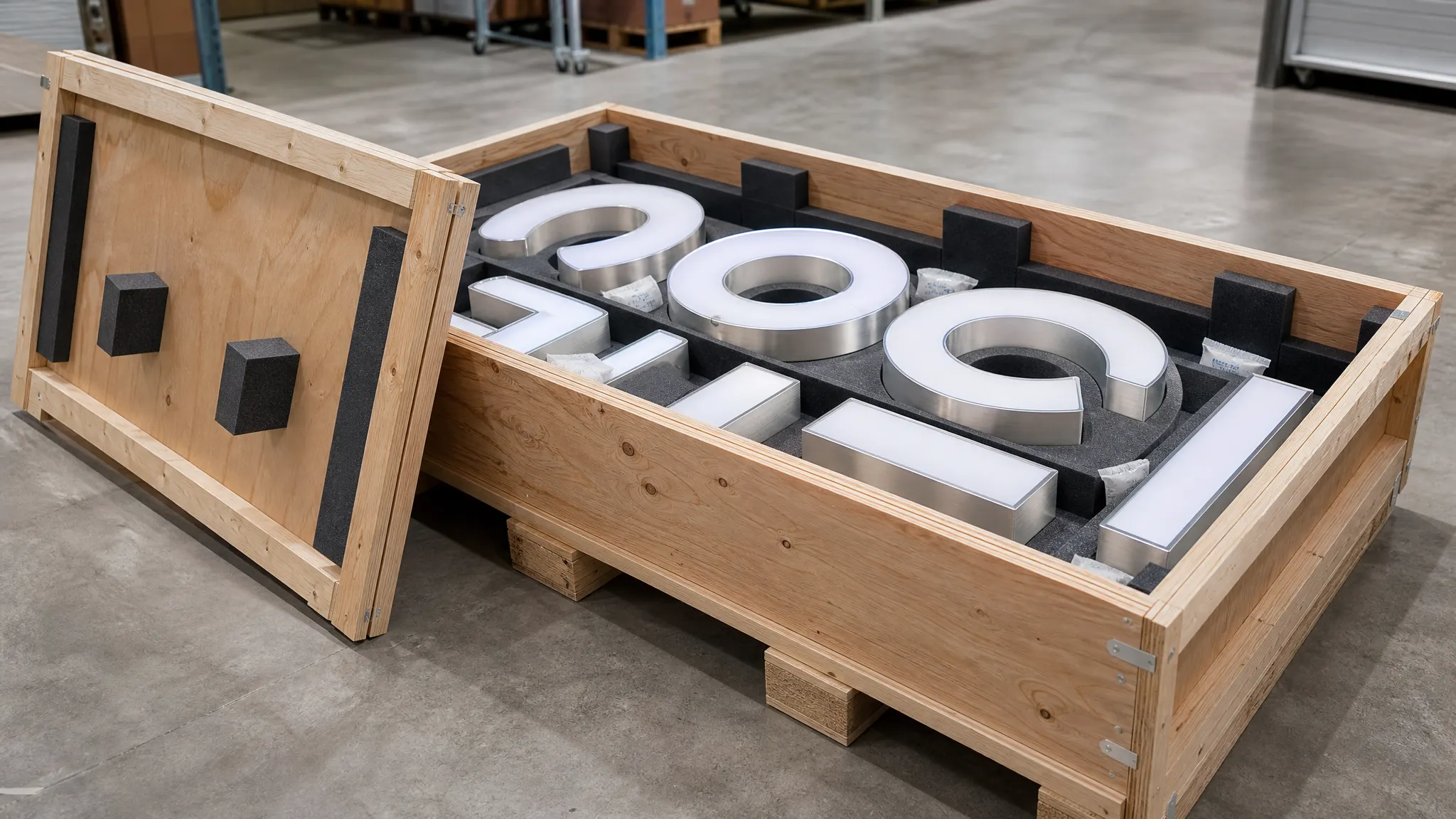
Three rules govern every crate. It is an A-frame, so the load cannot slide flat against a truck wall and faces never rest on a hard surface. Letters are suspended, not packed: foam cradles hold each one off the crate floor so vibration dissipates into foam, not into the mounting studs. And it is rigid enough to be stacked and forked — 2×4 skids, plywood gussets, and a screwed lid instead of staples, which pull out on the first handling cycle.
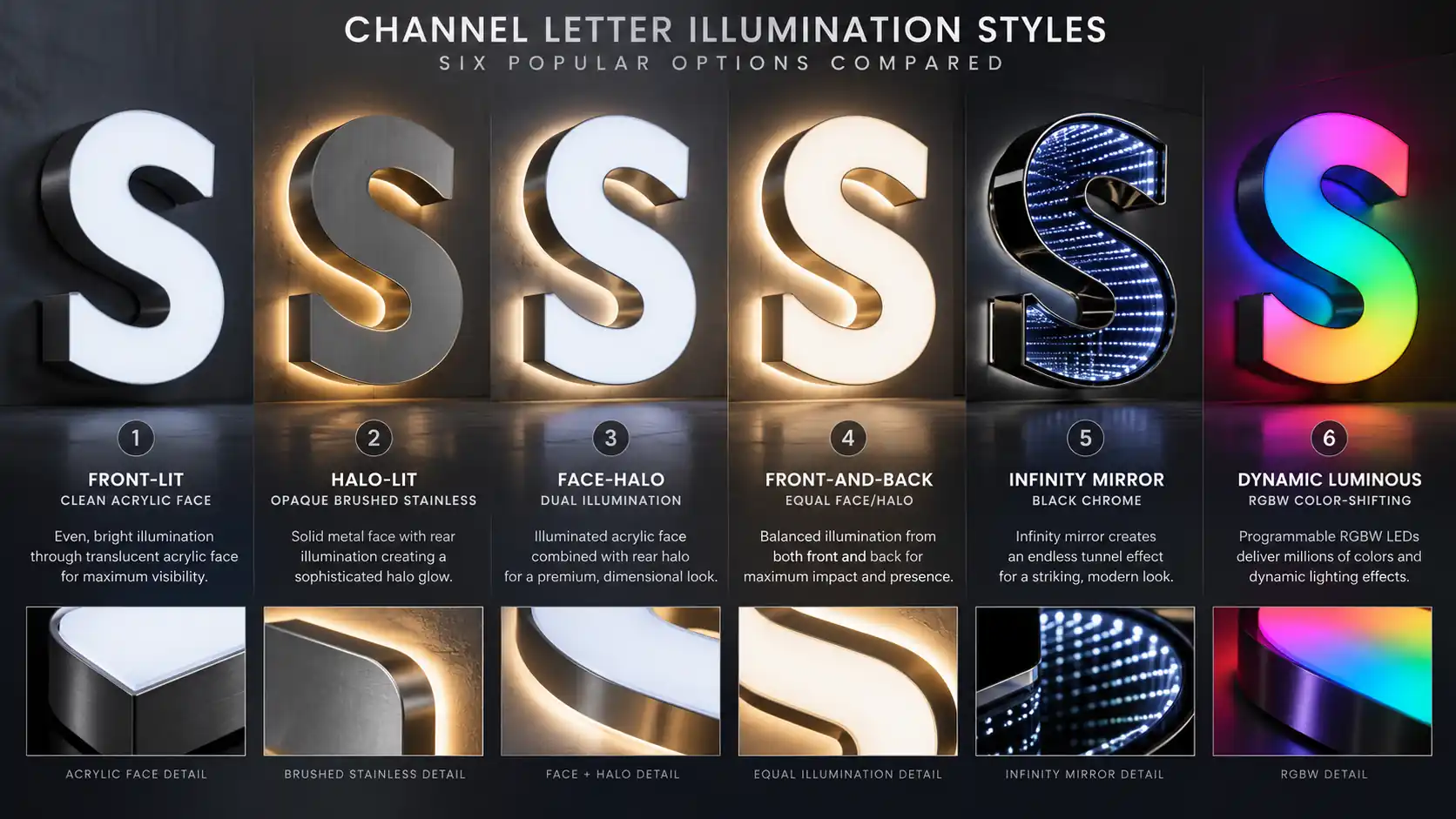
Spliced sets go into modular crates numbered by segment, each alignment pin in its own foam block — pins are the most fragile feature on a spliced letter. Per family: front-lit letters travel in 1/2-inch A-frames with 2-inch foam; front-and-back-lit letters add foam between face and acrylic back panel; infinity mirror letters use 3/4-inch plywood, 3-inch foam and a moisture-controlled interior, because mirror film is the least forgiving surface we make. Halo-lit letters add a foam gap behind the return to protect the standoff edge.
Inside the Crate — Six Protection Layers
Six layers sit inside every crate we build. Each answers a specific failure we have seen or tested.
1. Face protection film. A removable film goes onto the acrylic face and stays on until installation day, preventing the fine scuffing that happens when a face brushes cardboard. It peels clean with no residue — provided it is not left in direct sun for months. Remove it within weeks, not seasons.
2. Corner guards. Every corner gets a high-density foam block plus a corrugated wrap. Corners concentrate impact: a crate set down hard on concrete transfers shock into the nearest letter corner, and foam spreads it across a larger area of the return.
3. Return and back protection. Foam pads sit wherever a return or back pan could contact the crate or another letter. On painted returns a single point load leaves a mark that cannot be polished out without repainting the letter.
4. Internal bracing. Foam blocks sit between letters so nothing shifts independently; the contents behave as one rigid mass. Letter-to-letter contact is the top cause of face damage in transit.
5. Desiccant packs. Two to four units per crate, more for mirrors and electronics. This is about condensation, not rain: a crate that crosses a cold night then sits in a warm humid warehouse forms moisture on cold surfaces inside. Desiccant keeps interior air dry through that cycle, protecting modules, drivers and mirror film.
6. Shock and tilt indicators. Tip-N-Tell and ShockWatch labels go on the crate exterior, visible to every handler. Tip-N-Tell turns red past a set tip angle; ShockWatch turns red above a rated impact. They are why a carrier cannot claim the crate left the dock perfect — cheap labels that turn an argument into documented fact.
Shipping Methods & Lead Times
| Method | Transit (US) | Best for | Cost vs base |
|---|---|---|---|
| LTL, palletized | 3–7 business days | Standard sets up to 120″ | Base |
| Dedicated truck | 2–5 days | Over 120″, multi-crate, fixed dates | +40–60% |
| Air freight | 1–2 days | Emergency replacement, international | +150–200% |
| Ocean container | 20–35 days | International volume, 10+ crates | Base at volume |
LTL is the default for a single storefront: palletized, banded, moved through a terminal network with two to four extra handling touches. Cost-effective, provided the crate is built for terminal handling and not just a forklift at each end.
Dedicated truck wins when a crate exceeds 120 inches, when four or more crates must stay together, or when the crew is booked for a fixed date. Freight never enters a terminal — loaded once, driven, unloaded once. The adder is real; so is the drop in handling events.
Air freight covers replacements, immovable openings and international deadlines. Ocean freight is the default for international volume: ten-plus crates fill a partial container efficiently, with time and humidity handled in the crate spec.
Confirm two details at order, not when the driver calls: dock or liftgate, and whether the address accepts a tractor-trailer.
International Shipping — What Changes
Cross-border shipments add compliance requirements, and they change how the crate is built.
ISPM-15. Solid wood packaging — crates, pallets, dunnage — entering most countries must be heat-treated and stamped to the ISPM-15 standard. An unstamped crate can be refused entry, fumigated at the importer’s expense, or returned. Every international crate we build carries the stamp.
Climate control. Infinity mirror and dynamic luminous products ship in climate-controlled containers where the route justifies it, at roughly a 15% premium. A dry container crossing the tropics swings between heat and humidity — the two conditions mirror film and electronics tolerate worst.
Documentation. Commercial invoice, packing list and certificate of origin come from us, itemized by crate so customs reconciles paperwork without opening every box.
Terms. DDP (Delivered Duty Paid) gives buyers one landed number — we handle brokerage, duties and final delivery. FOB and CIF suit buyers with their own forwarder. We ship regularly to the US, Canada, the EU, UK, Australia, New Zealand, the UAE, Singapore, Hong Kong, Japan, Korea and Mexico, with drivers supplied for destination voltage (120V UL-listed in North America, 230V in the EU and UK).
Receiving Checklist — Do This Before You Sign the BOL
The bill of lading decides who pays for damage. Signing it without an exception note is, under most carrier tariffs, an acknowledgment that the shipment arrived in good condition. Inspect before the driver leaves:
- Count crates against the BOL. Note shortages at the tailgate — a missing crate found next morning is a much harder claim.
- Inspect every crate exterior. Crush marks, punctures, water staining, torn wrap, footprints.
- Read the shock and tilt indicators. Green or silver is clear; red means tipped or impacted — photograph it and write it on the BOL before the driver leaves.
- Open carefully. Cut bands, remove lid screws, lift the lid off — never pry with a bar, which slips into the letters.
- Inspect each letter. Face scratches under the film, return dents, corner cracks, back pan separation.
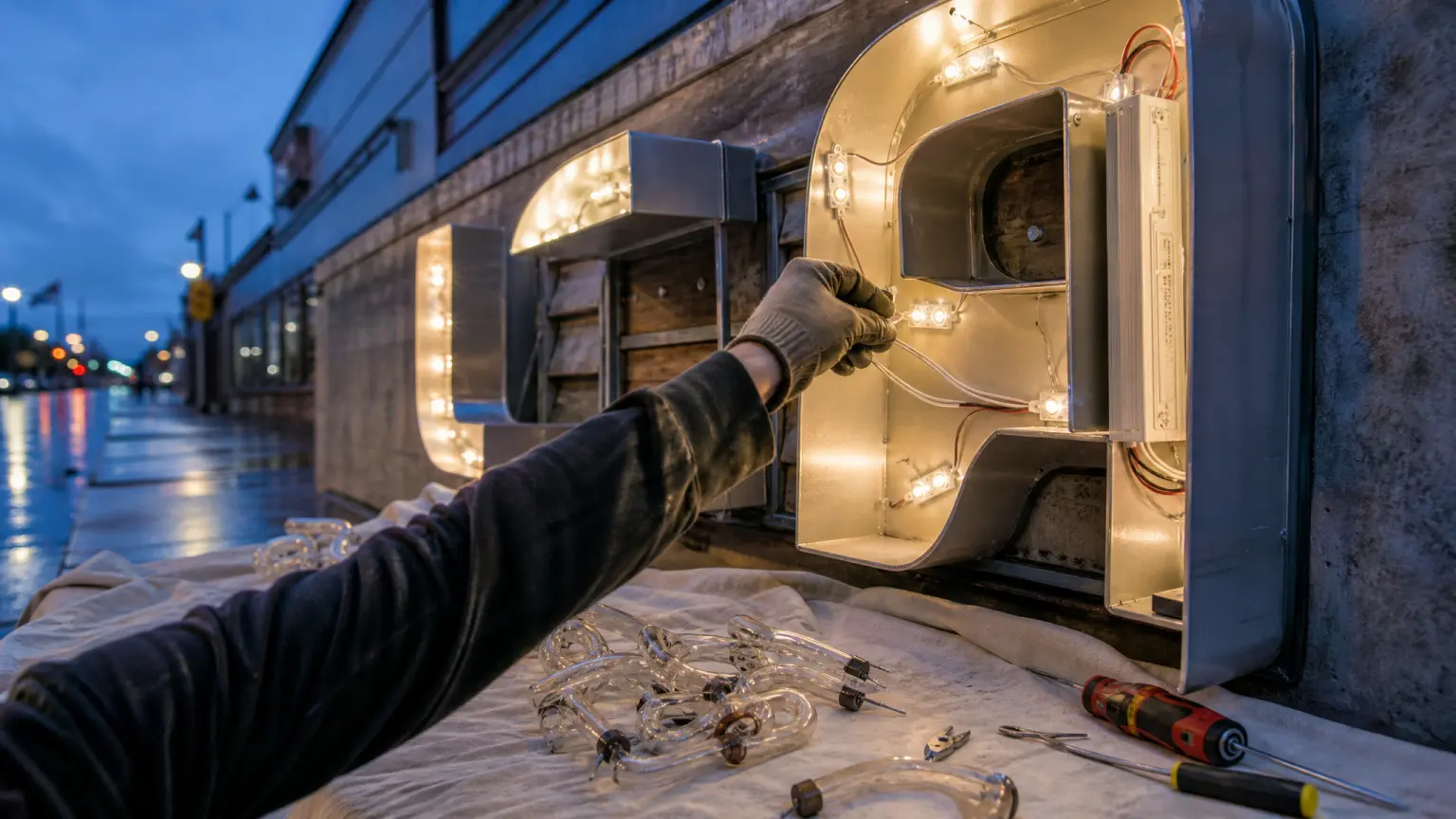
- Power-test every letter. A 120V pigtail ships with the order, so each letter bench-tests from a standard outlet in about two minutes — far cheaper on the ground than 20 feet up.
- Document everything. Photograph crate exterior, each indicator, each letter, plus a short video of the open crate.
- Note condition on the BOL — “Received in good condition” or “Damage noted — see photos attached” — then get the driver’s signature and keep your copy.
Concealed damage has a 24–48 hour claim window, which is the argument for opening crates the day they arrive, not the day before installation. Treat receiving signage as a supervised process, not a signature at the curb.
Common Damage Types & Root Causes
Almost all sign shipping damage falls into six categories, each tracing to a handling event a crate can survive.
| Damage | Root cause | Prevention |
|---|---|---|
| Face scratches | Forklift tine contact, crate shift | Face film, foam face pad, internal bracing |
| Return corner dents | Crate corner impact, bad stacking | High-density foam guards, double-wall corners |
| Cracked acrylic | Vibration plus thermal shock | Foam suspension, climate control on long routes |
| Loose LED modules | Vibration fatigue at mounting points | Factory torque spec plus threadlocker |
| Driver failure | Moisture ingress into driver enclosure | Desiccant, sealed driver box, weep holes |
| Mirror delamination | Thermal cycling in transit | Climate control, desiccant, mirror corners |
Note the fabrication-side cause: loose LED modules usually start as a torque or threadlocker mistake, not a packing failure — which is why a power test is worth doing even when the crate looks perfect. Driver and module certification specs are covered in our UL/ETL guide.
Claims Process — We Handle It
When damage happens, the buyer’s job is documenting it. Everything after that is ours.
We file the claim on our account, using our freight relationship, and supply the crate documentation, shock indicator evidence and packing list. Because crating is specified and documented, carrier liability is usually clear rather than contested — in our experience roughly 98% of properly documented claims are approved.
In parallel, replacement letters enter a priority fabrication queue: 5–10 business days, faster than a new order because tooling, artwork and color match already exist. The replacement ships by whatever method arrives soonest, and its cost, freight and deductible are absorbed on our side. You receive a replacement, not an invoice. The one thing we ask is speed on documentation — a claim filed inside the carrier window with clear photos is routine; one filed three weeks later is a negotiation.
Site Storage Before Install
Crates arriving before the crew need somewhere to live, and storage matters as much as transit.
Indoor storage is the default. Climate-controlled space at 60–80°F and 30–50% relative humidity is ideal — a retail space, back office or garage. Keep crates off bare concrete; a pallet stops moisture wicking.
Outdoor storage is a compromise. If indoor space does not exist, crates can sit outside for about two weeks if covered, raised off the ground, shaded and clear of standing water. Tarps must be ventilated, not sealed — a sealed tarp traps condensation and defeats the desiccant. Infinity mirror and dynamic luminous products should never be stored outdoors at any duration; a week in a sun-exposed lot can undo the protection built into the shipment.
Stacking: two crates high maximum, heaviest at the bottom, arrows up. Never lay an A-frame crate on its side to save floor space — the geometry assumes letters hang vertically.
Install-Day Logistics
The cheapest damage to prevent is damage caused on site — a crate arriving at the wrong time, or coming off the truck with the wrong equipment.
Same-day delivery and install. Where the schedule allows, we book crate delivery for the morning of installation: off the truck, inspected, letters up — no interim storage, no second handling cycle. The delivery appointment and crew arrival should share a window, not just a day; a crate left on a sidewalk is exposed to weather, theft and traffic.
Equipment. Tell us at order whether the site has a dock, a forklift, or neither. A liftgate delivery needs a liftgate truck and a receiver with a pallet jack; a dock delivery does not. Getting this wrong means a redelivery fee and a lost day.
Empty crate removal. We take empty crates back or arrange recycling — three A-frames is a real dumpster line item if nobody plans for it, and our crates use screws so they reopen and return.
For mounting specifics see our mounting methods comparison; for site-side electrical prep, the installation guide has the checklist.
Your Receiving SOP (Copy-Paste for Your Team)
Print this, tape it inside the site office, and give a copy to whoever signs for freight — it is written for someone who has never received signage before.
[ ] BOL count matches PO
[ ] Exterior inspected: no crush, puncture, water, tip
[ ] Shock indicators: all clear (green/silver)
[ ] Crates opened: face film intact, foam in place
[ ] Each letter: face clean, returns straight, corners sharp
[ ] Power test: all LEDs illuminated, no flicker
[ ] Photos taken: crate exterior, each letter, any issues
[ ] Notes on BOL: "Received in good condition" or "Damage noted — see photos"
[ ] Driver signature obtained
[ ] Notify project manager within 1 hour
Two habits make it work. Inspect before signing, every time, even when the driver is in a hurry — ten minutes saved can cost a month. And photograph everything, including crates you believe are fine.
Replacing an existing storefront sign? Compare retrofit versus new build before you order. Still choosing a letter style? Start with the front-lit buyer’s guide or compare face-halo and front-and-back-lit letters. For mirror or color-changing products, the infinity mirror guide and dynamic luminous overview cover the crating implications. Everything we ship leaves crated, insured and documented — if something arrives wrong, send us the photos and we start the replacement the same day.