Two fabricators quote the same 24-inch front-lit letters and come back $1,300 apart — per letter. Faces, returns, LED modules and drivers are identical. What differs is the mounting method: how the sign attaches to the wall, where the power supply lives, and how many holes someone drills in a facade that may belong to your landlord.
Four channel letter installation methods matter: raceway, flush mount, wireway and direct/stud. They are not priced the same, and the wrong one will either be rejected at permit review or look wrong for twenty years.
Mounting Method = 40% of Install Cost, 100% of Visual Outcome
On a typical channel letter project, fabrication runs 55–65% of the invoice and installation 35–45%. Mounting is the biggest lever in that install half: crew hours, lift time, anchor count, conduit runs, the electrician’s scope. Moving a 30-letter package from raceway to flush mount routinely adds $12,000–$20,000 — not because flush letters are harder to build, but because they are harder to install and service.
The visual side is absolute. A raceway puts a visible box behind your letters; flush leaves nothing but letters floating 1.5–3 inches off the wall. On a 40-foot strip-mall fascia nobody notices the box; on a limestone bank in a historic district it is the first thing the review board rejects.
Four parties can veto a method, and all four should be answered before you sign a quote. Your landlord controls penetration count, raceway paint color and restoration clauses. Your architect controls standoff depth, finish and whether the sign reads as part of the building. The fire marshal controls electrical accessibility and disconnect location. And code — ADA protrusion, wind load, seismic — controls what is legal on that wall.
Raceway Mount — The Workhorse (70% of Installs)
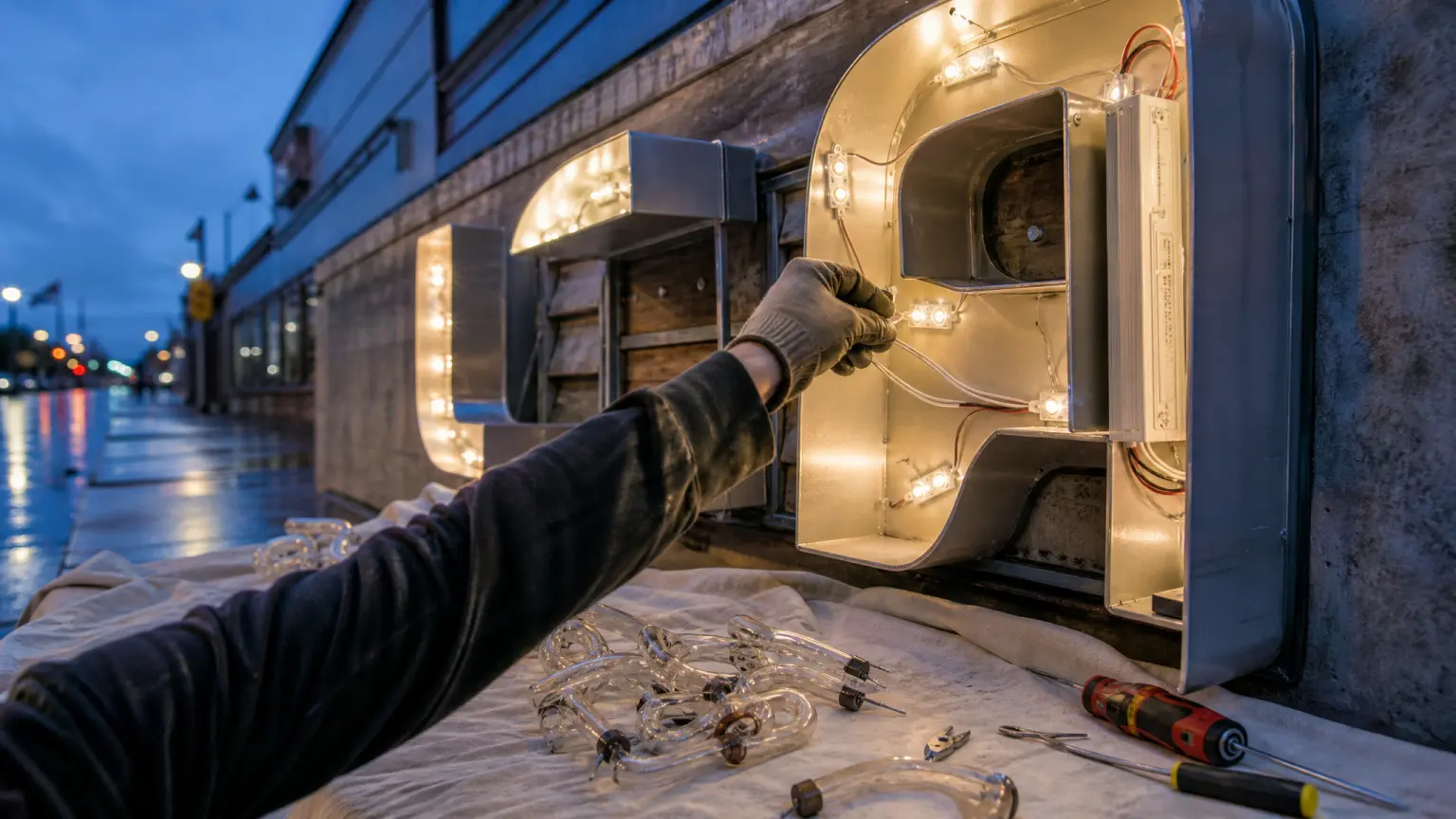
A channel letter raceway (also called a raceway box, pan or mounting box) is an aluminum enclosure, typically 4″ × 3″ with .063″ wall, fastened to the facade. The letters mount to its face. Drivers, terminal blocks and low-voltage wiring live inside, and one conduit carries line voltage through a single wall penetration. One hole in your facade whether the sign has 12 letters or 32. That is the single reason the channel letter raceway is the default on most US storefront work.
Good raceways ship with a hinged or removable cover that opens without disturbing the letters — which is why raceway is the fire marshal’s favorite: the disconnect and driver are both reachable in seconds from a ladder, at the sign rather than inside the building.
- Fastest install: 4–6 hours for a storefront package, one conduit, one anchor pattern, letters pre-spaced on a paper template.
- Hides the power supply: no remote driver room, no attic access, no soffit panel to cut.
- Landlord-friendly: one penetration instead of one per letter, removable with a patch-and-paint at move-out.
- Fire-marshal preferred: accessible disconnect and serviceable wiring in a listed enclosure.
- One permit path: a single self-contained assembly keeps sign and electrical permits simple.
The trade-offs are honest. The box is visible — from the side, a band roughly 3 inches proud of the wall — and the sign projects deeper than flush, which shows on shallow fascias or when the sign is seen sharply down the street. Raceway color is a design decision: match the facade and the box disappears, match the returns for a monolithic look, or spec a custom RAL for rollout consistency. Coastal locations get powder coat, because salt spray destroys a thin liquid film on aluminum within two seasons. Full spec detail is in the front-lit channel letters buyers guide; the line itself is front-lit channel letters.
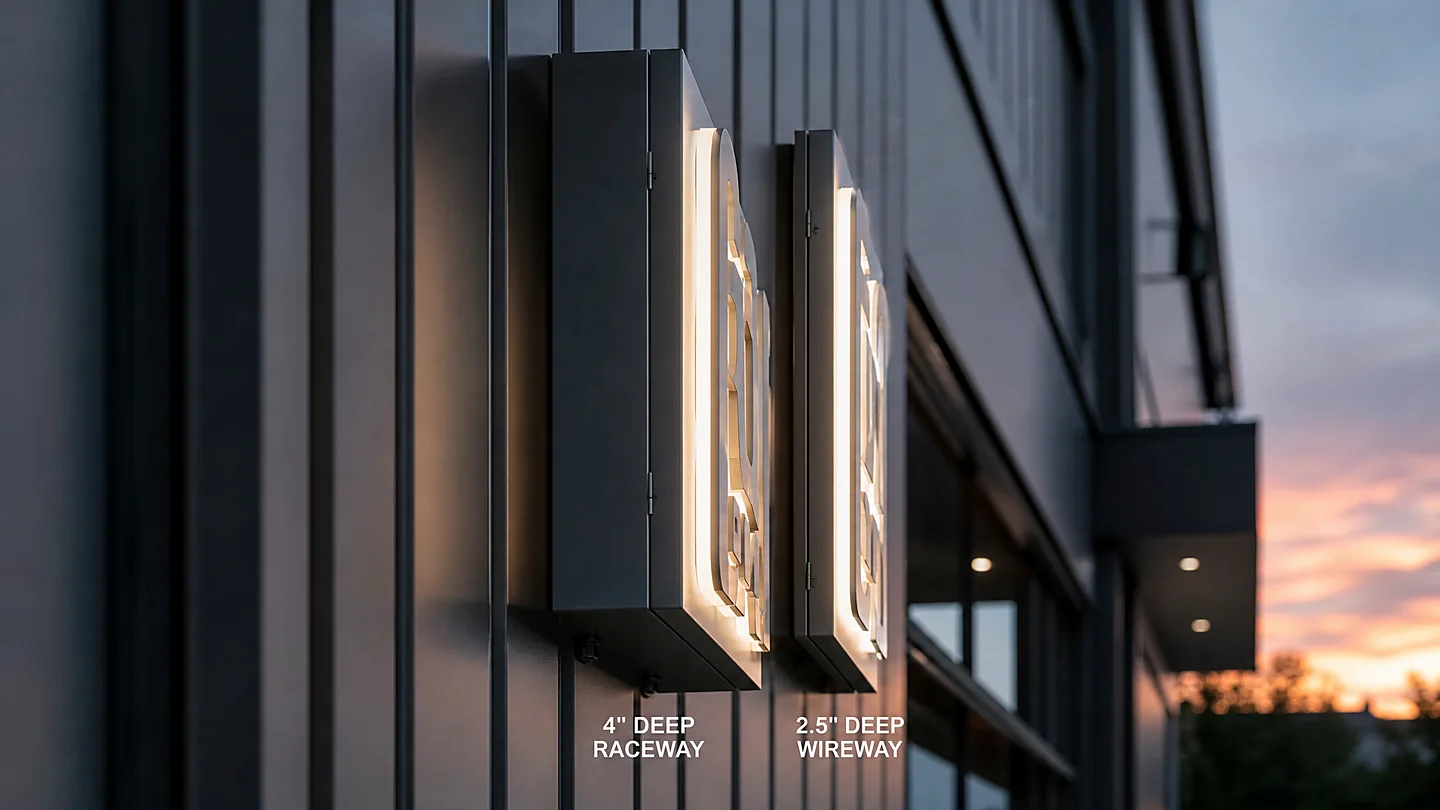
Standard depth is 4″ × 3″; a shallow 2.5″ raceway stays inside the 4″ ADA protrusion limit without giving up a housing. Raceway is also the default for halo-lit letters, because rear glow needs the standoff the box already provides.
Flush Mount — The Architect’s Choice
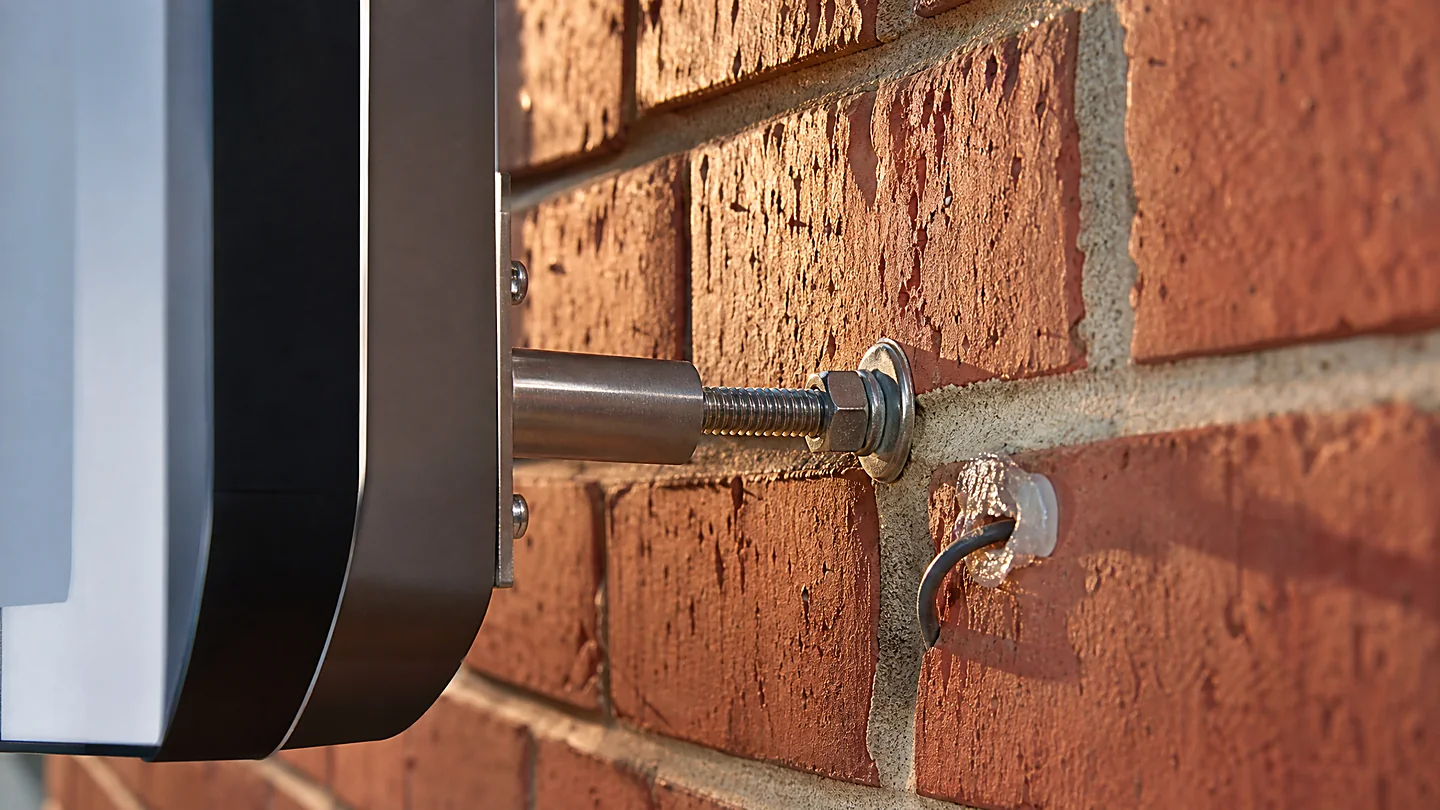
Flush mount hangs each letter directly off the facade on threaded standoffs — usually 5/16″ to 3/8″ stainless rod set with epoxy or mechanical anchors, with the letter threaded on and secured from behind. There is no box, each letter carries its own low-voltage feed, and the driver must live remotely: soffit, attic, mechanical room or electrical closet.
The remote driver is the whole engineering problem. DC loses voltage over distance, so the run to the farthest letter is normally capped near 50 feet; longer runs need heavier gauge, a higher-voltage system or a second driver bank. The driver also needs an accessible, code-compliant disconnect — in practice, an access panel the building owner must remember in five years.
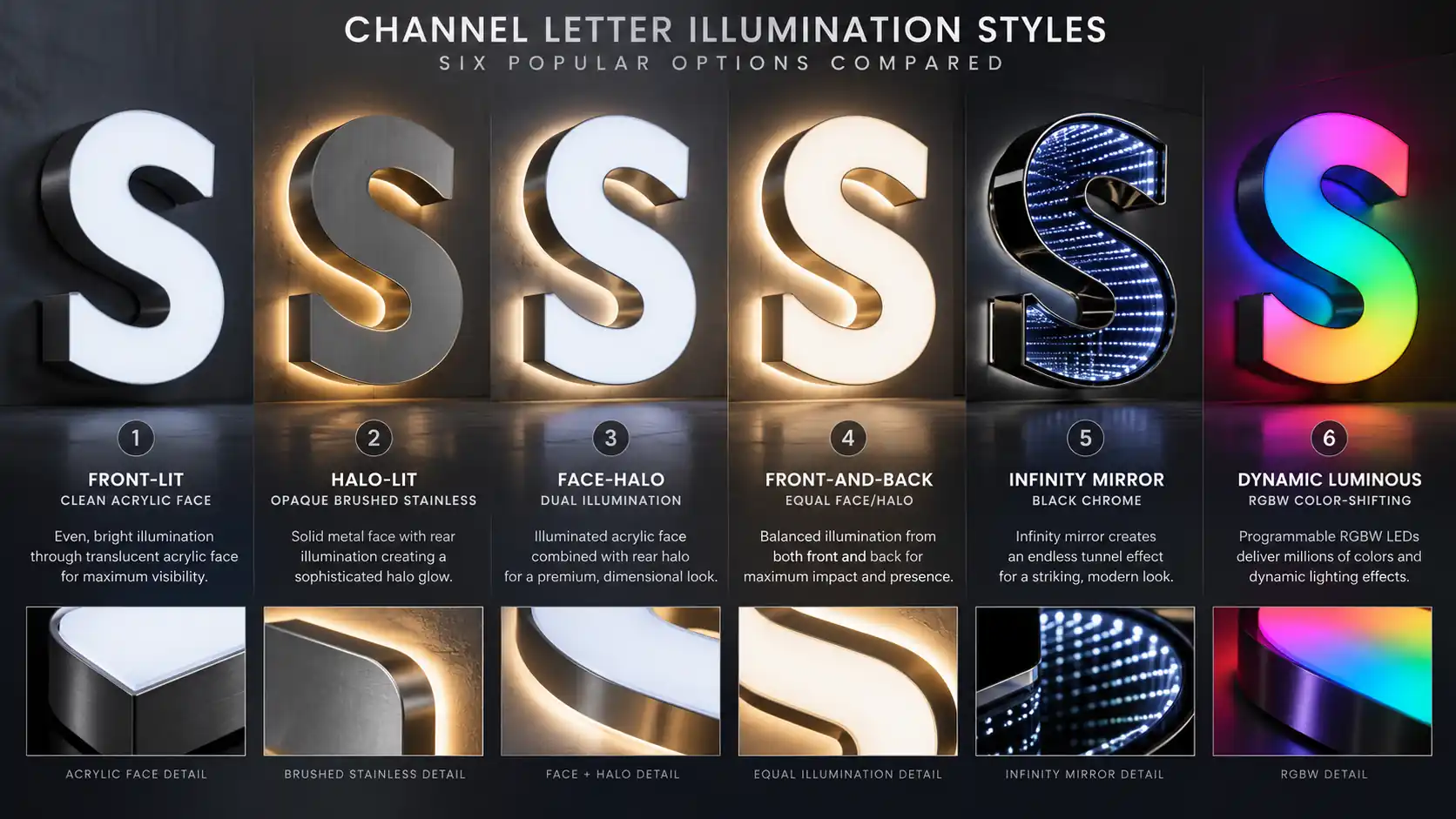
Standoff depth follows the lighting style: 1.5″ for front-lit (enough to vent the body and clear facade texture), 2″ for face-halo and reverse halo-lit (the gap that lets the rear glow spread without hot spots), and 3–4″ for infinity mirror letters, where the gap sets the depth illusion and keeps the mirror face out of arm’s reach.
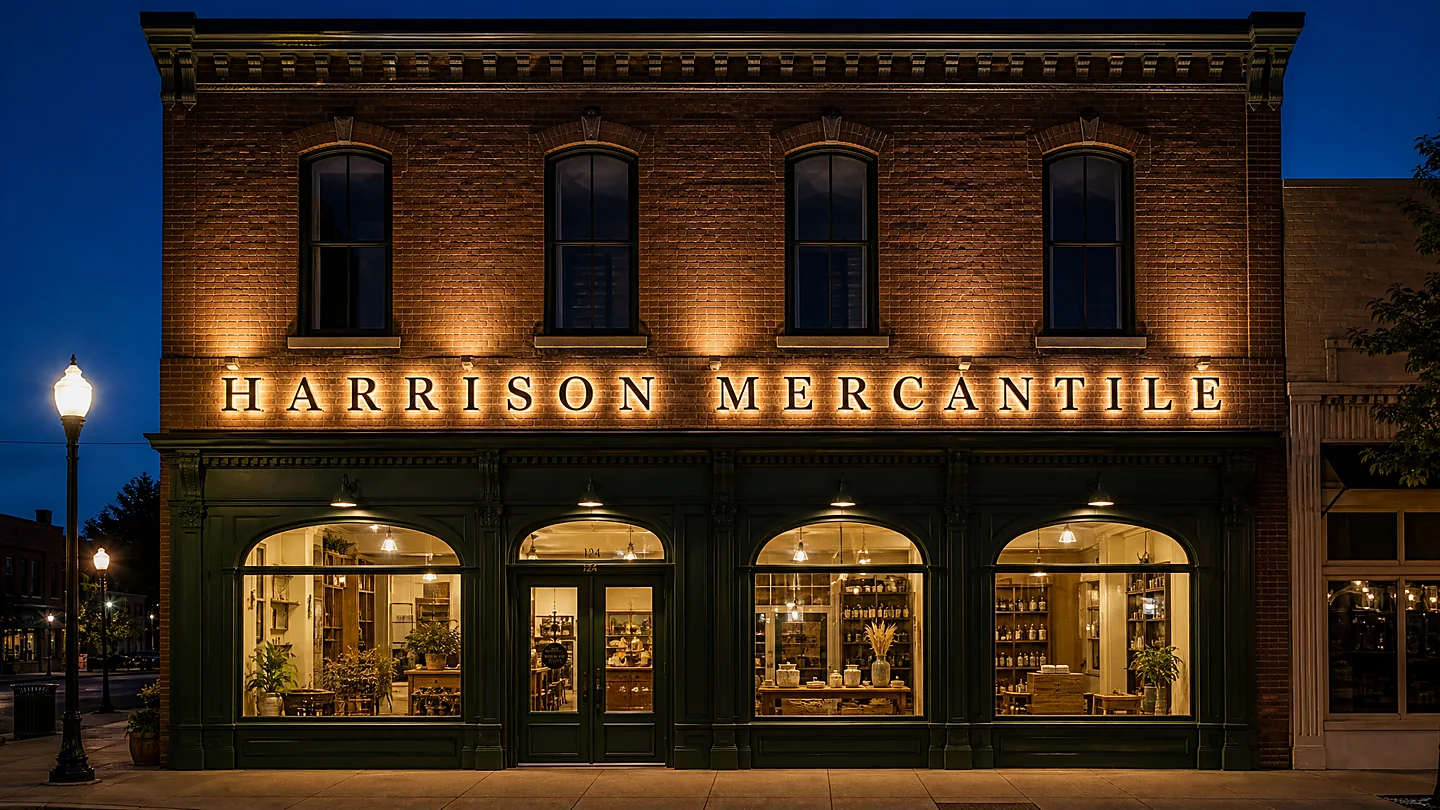
The payoff is the cleanest facade available: no box, no visible housing, letters that read as applied architecture. Flush dominates flagship retail, headquarters, museums and — critically — historic districts, where a raceway is usually treated as visual clutter and denied outright. See the halo-lit channel letters and front-and-back lit channel letters lines, plus the deep-dive on face-halo and front-and-back lit letters.
The cost is facade penetrations — one anchor set per letter — and 8–12 hours of install instead of 4–6, since every letter is individually plumbed, shimmed and wired. Wall flatness becomes your problem too: past 1/8″ of bow across the sign, letters will not read on a common plane, and the fix is shimming each standoff or switching to a raceway. We laser-survey the wall before fabrication for exactly this reason. For infinity mirror letters the standoff also sets the drama — see the depth and ROI analysis.
Wireway — The Middle Ground
A wireway is a raceway slimmed down: typically 2.5″ × 3″, sized to carry wiring and a compact driver rather than a full driver bank. It does everything a raceway does — single conduit, hinged cover, accessible wiring, one penetration — with roughly 40% less visual mass behind the letters.
Wireway sign mounting earns its place where a project wants raceway practicality but the architect will not accept a 4-inch box: mid-rise retail, mixed-use ground floors, restaurant facades, thin metal panels. It is also the answer when a landlord approves a raceway in principle but wants a lower profile.
- Pros: less bulk than a raceway, one conduit, accessible cover, simpler than a remote-driver flush mount, $200–$400 per letter cheaper than flush in labor.
- Cons: less internal volume, so high-output signs may still need a remote driver; deeper than flush and readable as a slim band from the side.
Vendor language is loose: some shops apply “wireway” to a wiring channel that is not a structural housing at all. Ask for the drawing, not the word.
Direct/Stud Mount — Minimalist (Small Letters Only)
Direct mount is flush mount with the standoff removed: threaded studs welded or tapped into the back of each letter, anchored straight to the wall with no housing and no gap. Voltage must be low and runs short — in practice, letters 18 inches and under fed from a nearby remote driver.
It is the lowest-profile, cheapest-hardware option and the cleanest look on a smooth wall — and the most punishing to service: any failure means removing letters from the facade, then lift, template, reseal and re-anchor. We specify it only for small letters, interiors, or where a client accepts the service trade-off in writing.
Decision Matrix — Which Mount For Your Project?
Read the matrix by finding your constraint first, not your preference — it is the fastest way to settle raceway vs flush mount on a given wall. Landlord constraint → raceway column. Historic board or design architect → flush. A fascia that cannot take a 4-inch box but needs serviceable wiring → wireway.
| Factor | Raceway | Flush | Wireway | Direct/Stud |
|---|---|---|---|---|
| Install time (30-letter package) | 4–6 hr | 8–12 hr | 5–7 hr | 3–4 hr |
| Facade penetrations | 1 conduit | 1 anchor set per letter | 1 conduit | 1 anchor set per letter |
| Driver location | Inside box, hinged cover | Remote (soffit / closet) | Box if it fits, else remote | Remote only |
| Visual profile | Box visible (≈3″) | Cleanest — letters only | Low box (≈2.5″) | Near-flat |
| Landlord preference | ✅ Preferred | ⚠️ Many penetrations | ✅ Acceptable | ⚠️ Many penetrations |
| Fire marshal | ✅ Accessible disconnect | ⚠️ Needs access panel | ✅ Acceptable | ❌ No local disconnect |
| Historic district | ❌ Usually denied | ✅ Preferred | ⚠️ Case-by-case | ✅ Preferred |
| ADA (4″ protrusion limit) | Shallow 2.5″ raceway | ✅ Compliant | ✅ Compliant | ✅ Compliant |
| Labor cost | $ | $$$ | $$ | $ |
| Best for | Chains, strip-mall, ~70% of installs | Flagship, historic, architect-led | Mid-rise retail, thin fascias | Letters under 18″ |
Two combinations recur. A chain storefront that wants raceway simplicity on a picky facade: shallow raceway powder-coated to the fascia color, satisfying landlord and ADA at once. A boutique fitness studio that wants halo glow on brick: flush mount on 2-inch standoffs with the driver in the ceiling grid, covered in the fitness studio channel letter guide.
Code & Permit Nuances by Mount
NEC Article 600. Electric signs need an accessible disconnecting means within sight of the sign, listed components and a factory-applied UL/ETL label. Raceway and wireway make that automatic — the disconnect sits in or at the box. Flush mount pushes the question to the remote driver, where an access panel is mandatory and the inspector will want it on the drawing. Concealed-driver direct mount is the hardest path to defend.
Historic districts. Preservation boards judge visual clutter and reversibility. A raceway is a permanent box on a historic facade; flush letters on threaded rod are removable and leave small patchable holes. Raceway is denied in most locally designated districts, and flush or direct is the path that clears — the hotel and B&B signage guide covers approvals in Charleston, Savannah and New Orleans.
Wind load. Flush transfers load letter by letter into the structure through engineered anchors. A raceway adds sail area: box plus letters behave as one large plate, so the anchor schedule must be engineered for the combined area and the box stiff enough not to bow between anchors. On a 60-foot fascia in a 115 mph exposure category that is real engineering. We supply stamped mounting details and wind calcs with every submittal.
Seismic. In higher seismic categories flush letters need engineered anchors with edge-distance calculations in masonry; raceways need two load paths — box to structure, letters to box. Both cost more than the non-seismic version and neither is install-morning improvisation.
Paperwork. Whatever the mount, the sign must arrive with a UL/ETL label applied at the factory, because field labeling is a delay you cannot schedule around. The UL/ETL certification guide covers what inspectors check; the sign permit guide covers the US filing sequence by jurisdiction.
Facade Material Compatibility
The wall decides as much as the design does. This is the short version we use on intake calls.
| Facade | Raceway path | Flush path | Watch out for |
|---|---|---|---|
| Masonry / brick / stone | Expansion anchors into block or brick, box bedded and sealed | Threaded rod + structural epoxy or wedge anchors | Brick veneer with no backup — anchors must reach the structural wythe |
| Stucco / EIFS | Preferred: fewer penetrations, sealed at the box | Z-clip or rail system bridging to studs | EIFS has no structural value; hit sheathing or framing |
| Metal panel (ACM, ribbed) | Self-tapping into panel plus backup plate | Z-clip / rail with isolation washers | Thermal bridging; panel oil-canning under load |
| Glass / curtain wall | Framed raceway with structural silicone plus mechanical backup | Engineered mullion clamps only | Needs a glazing engineer and owner sign-off |
| Wood / siding | Lag bolts into studs, box flashed at top | Lag plus epoxy into solid blocking | Water intrusion — flash every penetration |
| Precast / tilt-up concrete | Cast-in or wedge anchors, box isolated from panel joints | Threaded rod plus epoxy, edge distance checked | Panel joints move; never anchor across a joint |
Two rules survive every facade. Water is the enemy: one hole or twenty, seal every penetration and give every raceway a weep path so condensation exits instead of pooling behind the letters. And an anchor is only as good as what it bites into — a 3-inch epoxy anchor into 5/8-inch sheathing holds nothing.
Maintenance Access by Mount
Signs fail predictably: a driver, a module, a face, a photocell. Mounting decides what it takes to reach the failure.
| Mount | Driver swap | Module / face swap | Service call |
|---|---|---|---|
| Raceway | Open hinged cover, 15 min | Remove face, 15 min per module | One tech, one ladder |
| Wireway | Open cover, 15–30 min (tighter access) | Remove face, 20 min per module | One tech, one ladder |
| Flush | At remote driver, 15 min, indoors, no lift | Lift or bucket truck, opened in place | Two people, one lift |
| Direct/Stud | At remote driver, 15 min | Letter removed, template and reseal | Two people, lift, half day |
The pattern: flush is easiest to service electrically and hardest optically — driver indoors, LEDs 25 feet up. Raceway is the reverse: everything at the sign, behind one cover. Over ten years that gap outgrows the install gap. Replacement modules must match the original color and CCT bins or the sign shows a patchwork at night — the 3000K vs 4000K vs 6500K guide explains how to specify them.
Cost Comparison (Factory-Direct, 2026 USD, 24″ Letters)
Mid-market US numbers for 24-inch front-lit letters, factory-direct, excluding permit fees and the electrical rough-in to the sign location. The gap between methods holds across sizes, and the channel letter raceway also carries the lowest service cost — a line the install numbers below do not capture.
| Mount | Labor adder vs raceway | Mounting hardware | Typical installed total / letter |
|---|---|---|---|
| Raceway | Base | $150–$250 | $1,200–$1,800 |
| Flush | +$400–$700 | $200–$350 | $1,800–$2,800 |
| Wireway | +$200–$400 | $180–$300 | $1,500–$2,200 |
| Direct/Stud | Base | $100–$150 | $900–$1,300 |
The flush adder is four costs, not one: crew hours, anchor hardware, a remote driver installed by an electrician, and an access panel plus finish work. On a 20-letter sign, flush lands $10,000–$18,000 above raceway installed — defensible on a flagship, hard to justify on a tenant improvement. Letter size moves the number more than anything here, so we size before we price; see the channel letter size guide.
From Quote to Install — What We Need
Mounting gets decided twice: when the quote is built, and again at submittal. Answering these up front collapses both into one cycle.
- Facade photos and material — straight-on plus two oblique angles, and what is behind the finish. This sets the anchor schedule.
- Structural drawings — required for flush, and for any raceway over roughly 20 feet where wind load governs.
- Landlord approval — penetration permission, raceway paint color, restoration obligations at lease end.
- Architect sign-off — for flush: standoff depth, standoff finish (brushed, black, custom RAL), expected shadow line.
- Electrical source — where line voltage exists, and whether the driver can live at the sign or must go indoors.
- Install constraints — lift permits, dock hours, whether the storefront stays open.
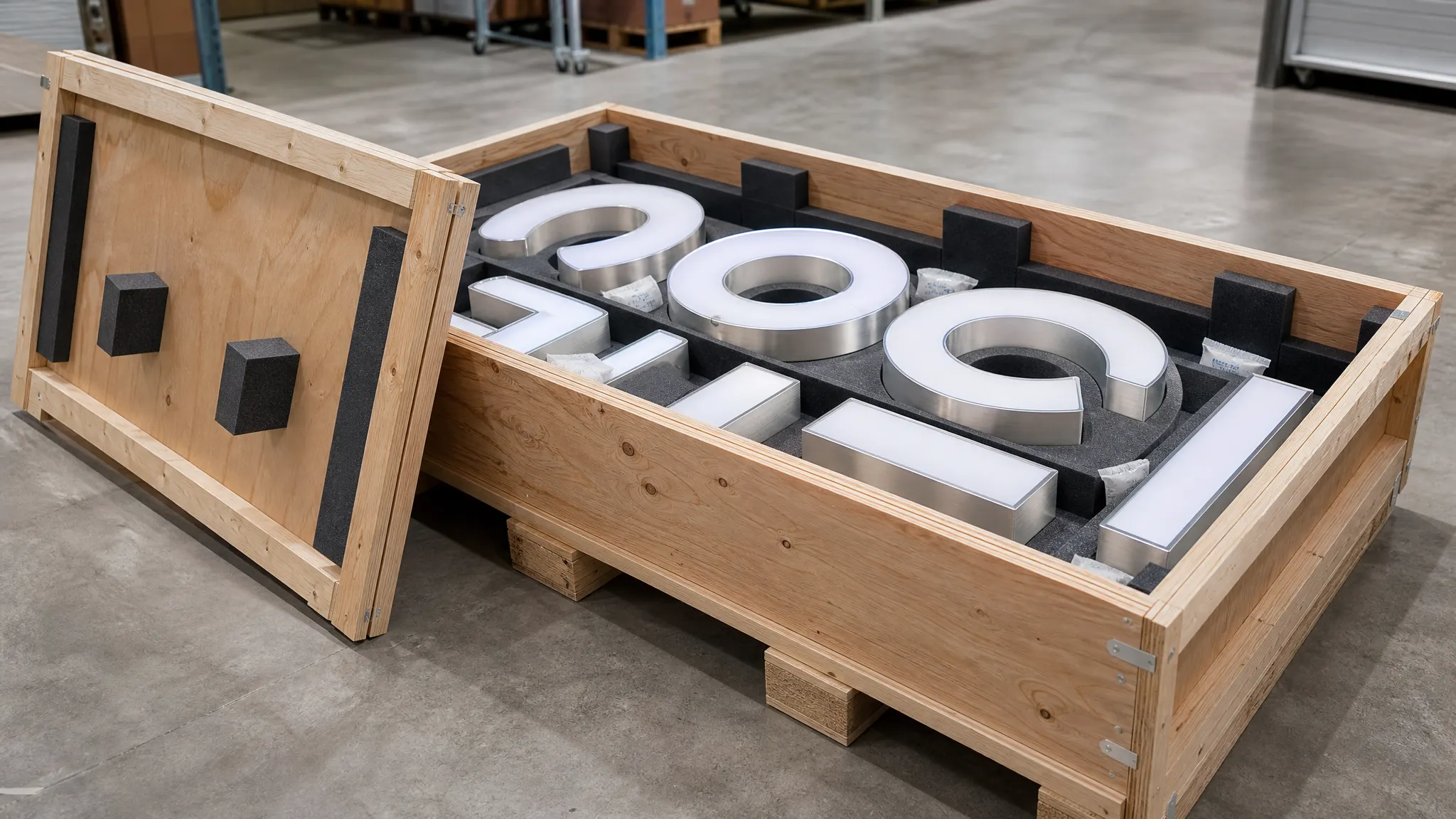
We return stamped mounting details, an anchor schedule, wind calcs where required, and a shop drawing showing where every hole goes — before anything is cut. Freight follows the mount: a raceway ships as one long crate, while flush letters ship individually and must be staged in install order. The shipping and receiving guide covers that handoff; the site sequence is in our installation guide.
Pick the mount before you pick the font. It sets your budget, your approval path and what the building looks like for the next twenty years — and it is the one decision on a sign project that is genuinely hard to reverse.