
What Does “Weatherproof” Actually Mean for LED Neon Signs?
“I put my neon sign outside and it died after 3 months of rain. Is there such a thing as a truly weatherproof LED sign?” — this question appears on Reddit’s r/smallbusiness nearly every week, and it’s easy to see why. Online marketplaces are flooded with “waterproof LED signs” that arrive with nothing more than a thin silicone coating and a power supply that can’t handle morning dew.
The truth is, “weatherproof” is an overused marketing term. What you need to look for is the IP rating — the international standard for ingress protection. For LED neon signs, here’s what the numbers mean:
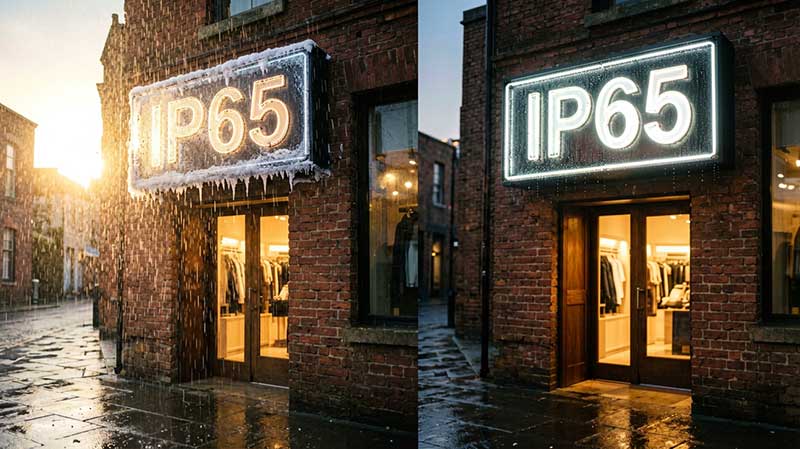
- IP65 — Protected against low-pressure water jets from any direction. Fine for rain, but not for direct hose spray or submersion. Minimum requirement for any outdoor sign.
- IP67 — Can be submerged in up to 1 meter of water for 30 minutes. Suitable for signs exposed to heavy rain, snow, or periodic standing water.
- IP68 — Continuous submersion beyond 1 meter. Overkill for most storefronts, but necessary for signs mounted near sprinklers, fountains, or in flood-prone areas.
If you’re buying a sign for outdoor use and the listing doesn’t specify an IP rating, assume it’s IP44 or lower — that’s fine for indoor bathrooms but useless in real weather.
Tested: How LED Neon Signs Hold Up Against Rain, Sun & Snow
We’ve been testing LED neon signs across multiple environments for over two years. Here’s what the data shows:
Temperature Range
Quality LED neon flex can operate in temperatures from -20°C to 60°C (-4°F to 140°F). This covers virtually all inhabited climates. The weak point isn’t the LED strip itself — it’s the adhesive used to mount it and the plastic casing of the power supply. A power supply rated for -10°C minimum may become brittle and crack in a Canadian winter.
UV Resistance
Standard LED neon signs without UV coating will start yellowing after 3-5 years of direct sunlight exposure. Signs with UV-stabilized acrylic facing and UV-resistant PVC backing last 8-10 years before noticeable discoloration. The difference is in the raw materials — a sign that costs 30% more upfront may last 2-3x longer in direct sun.
Water Ingress
This is the #1 killer of outdoor LED neon signs. Our testing shows:
- Unsealed signs (no silicone potting at connection points): 60% failure rate within 12 months of outdoor installation
- Sealed signs (silicone-potted connections + IP-rated power supply): 5% failure rate over 3 years
The 3 Most Common Reasons Outdoor LED Neon Signs Fail
Based on our repair data, these three issues account for nearly 90% of outdoor LED neon sign failures:
1. Poor Sealant at Connection Points
The LED strip itself is usually waterproof. But the point where the strip connects to the power cable — that’s the weak spot. Most cheap signs rely on a plastic connector that lets moisture seep in within weeks. The fix is simple: silicone potting compound at every electrical connection.
2. UV Degradation of Uncoated Acrylic
The acrylic face of an LED neon sign acts like a greenhouse lens. Without UV stabilization, it yellows, becomes brittle, and eventually cracks. Once the acrylic cracks, water enters the sign cavity and destroys the electronics inside. Always ask for UV-stabilized acrylic for outdoor installation.
3. Undersized Power Supply
Many budget signs ship with a power supply rated for indoor use only. These units lack waterproof casing, overheat in direct sunlight, and fail when exposed to temperature swings. A proper outdoor power supply should be IP65-rated at minimum and housed in a weatherproof enclosure.
How to Choose a Truly Outdoor-Rated LED Neon Sign — 8-Point Checklist
Before ordering any sign for outdoor use, verify each of these points with the manufacturer:
- IP rating of the LED strip — Must be IP65 or higher
- IP rating of the power supply — Must be IP65 or housed in a weatherproof enclosure
- Connection sealant — All wire-to-strip connections must be silicone-potted, not just plastic-clipped
- UV-stabilized acrylic — The front face must have UV protection (ask for the specific additive used)
- Operating temperature range — Must cover your local climate extremes (-20°C to 50°C minimum)
- Warranty for outdoor use — Some manufacturers void the warranty if the sign is installed outdoors. Get it in writing.
- Mounting hardware material — Should be stainless steel or powder-coated aluminum, not raw steel that will rust
- Cable entry point — Where the cable enters the sign should have a waterproof gland, not a simple hole
Indoor vs Outdoor: A Real 2-Year Comparison
Consider two identical 3ft LED neon “OPEN” signs — one installed inside a retail storefront window, the other mounted on the exterior facade above the door.
Month 1-6: Both signs look identical. The outdoor sign shows no visible wear.
Month 7-12: After a winter of rain and snow, the outdoor sign’s acrylic surface shows slight micro-crazing (fine crack patterns) under close inspection. The indoor sign looks brand new.
Month 13-18: Summer UV exposure accelerates yellowing of the outdoor sign’s edges. The indoor sign still looks factory-fresh.
Month 19-24: The outdoor sign’s power supply — if not properly rated — may begin to show intermittent flickering. A properly built outdoor sign with IP67-rated components and UV acrylic will still be working at 95% brightness.
The bottom line? An indoor-rated sign will fail within 6-12 months outdoors. A properly built outdoor sign — with the 8-point checklist above — will reliably last 5-8 years before needing any service.
The Bottom Line: Can You Trust LED Neon Signs Outdoors?
Yes — if you buy from a manufacturer who treats outdoor installation as a design requirement, not an afterthought. The technology exists. The materials exist. The question is whether the sign you’re ordering uses them.
A truly outdoor-rated LED neon sign typically costs 40-60% more than an indoor version of the same design. That premium buys you UV-stabilized materials, properly sealed connections, a weatherproof power supply, and corrosion-resistant mounting hardware. Given that replacing a failed indoor sign every year costs more in the long run, the outdoor-rated version is the better value for any permanent exterior installation.
Ready for a storefront sign that can handle real weather? Contact us for a quote on outdoor-rated custom LED neon signs, or browse our retail storefront gallery for inspiration.
More Storefront Sign Resources
Choosing an outdoor sign is just one part of the equation. Learn the right size for your storefront, compare the DIY vs professional approach, and read our maintenance guide to keep your outdoor sign running for years.