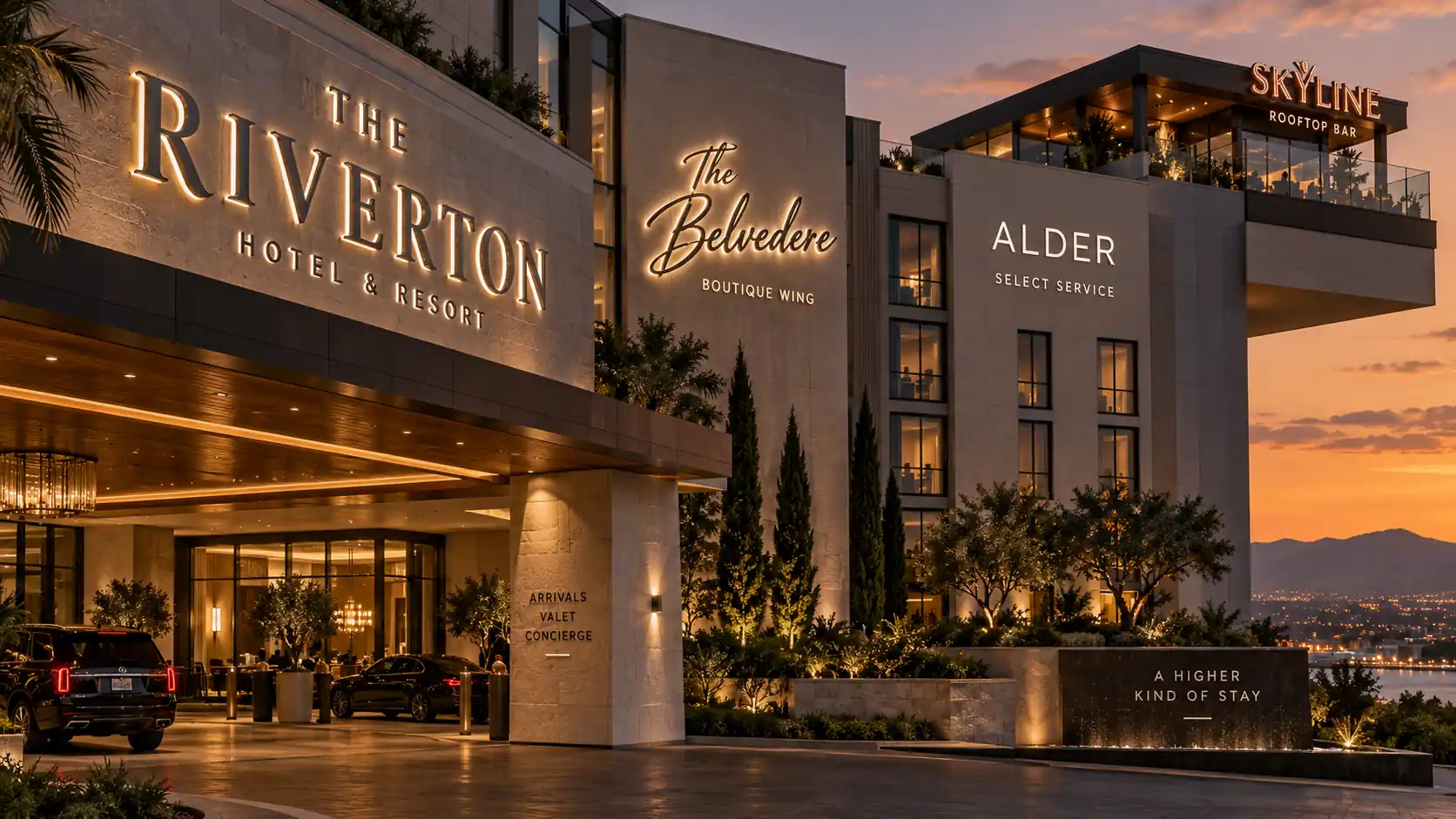
Hospitality signage is the silent concierge that works 24/7 — no shift changes, no sick days, no commission. A branded, illuminated storefront drives 12–18% more walk-in bookings than a generic awning or a dark facade. At $15–$25 in OTA commission savings per direct booking, a $5,000 face-halo sign pays for itself in 20–30 rooms. The guest journey — sign → lobby → room — becomes a cohesive brand story that an OTA listing simply cannot replicate. This guide breaks down the four channel letter lines that matter for hotels, B&Bs and resorts, how to match each style to your property tier, the code and brand standards that apply, sizing and color science, and the rollout playbook that takes a single flagship to fifty properties.
Hospitality Signage: The Silent Concierge That Works 24/7
Direct booking lift is measurable. A branded, illuminated storefront captures 12–18% more walk-in bookings than a non-lit or generic facade — figures consistent with STR and CBRE hotel investment studies on brand visibility. OTA commissions run $15–$25 per night, so every guest who books direct after finding you through your sign saves that margin. A 100-room property recoups a $7,000 face-halo flagship in roughly 20–30 occupied nights. Multiply that across a portfolio and the math compounds year over year — the sign is a revenue asset, not a marketing expense.
Guest journey continuity is where the real brand equity lives. The halo-lit script a guest sees on the boulevard should match the brushed stainless wayfinding in the lobby, which should echo the infinity mirror feature wall in the rooftop bar. One brand, one visual language, zero disconnect. An OTA shows a cropped, color-shifted photo; your sign shows the real thing, lit, every single night, at the moment of decision. That last-mile experience — the approach, the valet drop-off, the arrival glow — is what separates a hotel guests remember from one they forget the moment they check out. For brands operating several locations, that consistency is a differentiator worth engineering deliberately, which is exactly the thinking behind standardizing channel letters across multi-location brands.
A sign is also the only marketing asset a property cannot turn off. Ad campaigns pause, listings expire, and social posts fade, but a correctly lit facade works every night of the year, in both directions — it tells arriving guests they have found the right place, and it tells passing traffic that the property is open, lit and ready to receive them. That always-on presence, compounded across a portfolio, is why hospitality is one of the most demanding verticals for channel letter fabrication: the sign has to look right from the driveway and from the lot, in daylight and at 2 a.m., and it has to do so for decades without a visible refresh. Build it once, to the right spec, and it outlasts every digital channel you will buy this year.
Four Channel Letter Styles for Hospitality Brands
Not every property calls for the same line. Luxury, boutique, select-service and lifestyle concepts each have a channel letter style that fits its architecture, its guest and its price point. Here are the four that do the most work in hospitality.
Face-Halo / Front-and-Back Lit — Flagship, Luxury, Visible From Every Angle
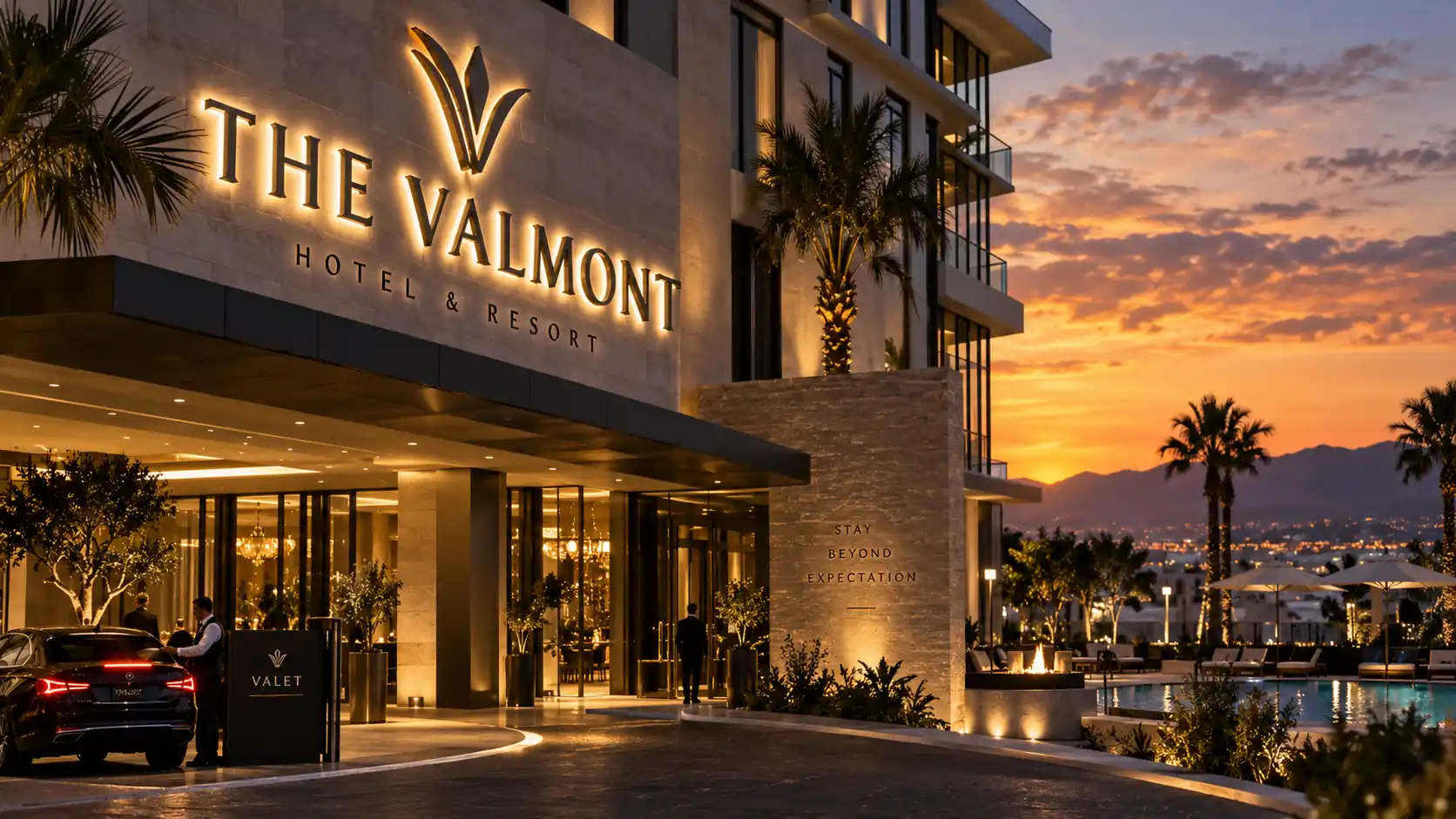
Dual illumination: an acrylic face glows forward while a rear halo glows backward. From the driveway you get crisp, legible brand identity; from the valet circle, the pool deck or the rooftop patio you get the warm halo silhouette. There are no dead angles, which is critical for sprawling resorts with multiple approach vectors and for destinations where guests arrive by car, boat or even on foot across an esplanade. The dual glow says “established, world-class, find us from anywhere.”
Best for luxury resorts, 5-star flagships and destination hotels where prestige needs to read from 100+ feet, day and night. Premium finishes — brushed stainless, anodized aluminum, black chrome — and dual LED arrays push the budget up, but the payoff in brand perception is the highest of any line. Explore the line in the front-and-back lit channel letters collection.
Halo-Lit Script — Boutique, B&B, Historic Inn
Reverse-lit (halo) letters mount 1.5–2″ off the facade, casting a soft glow behind opaque faces of brushed stainless, painted aluminum or Corten steel. The effect is floating warmth and architectural harmony at residential scale — no harsh face glare, which is why halo-lit is often the only style that clears approval in historic districts and Main Street programs. The glow reads as welcoming and intimate, which is precisely the tone boutique hotels and B&Bs want on approach.
Best for boutique hotels, B&Bs, historic inns and converted mansions where the building itself is the brand. Script and custom letterforms reinforce craft, heritage and a personal touch. Material choice matters here as much as the lighting style — see halo-lit letters: stainless, aluminum and acrylic compared, and browse the halo-lit channel letters line.
Front-Lit Clean Sans — Select-Service, Extended-Stay, Chain Rollout
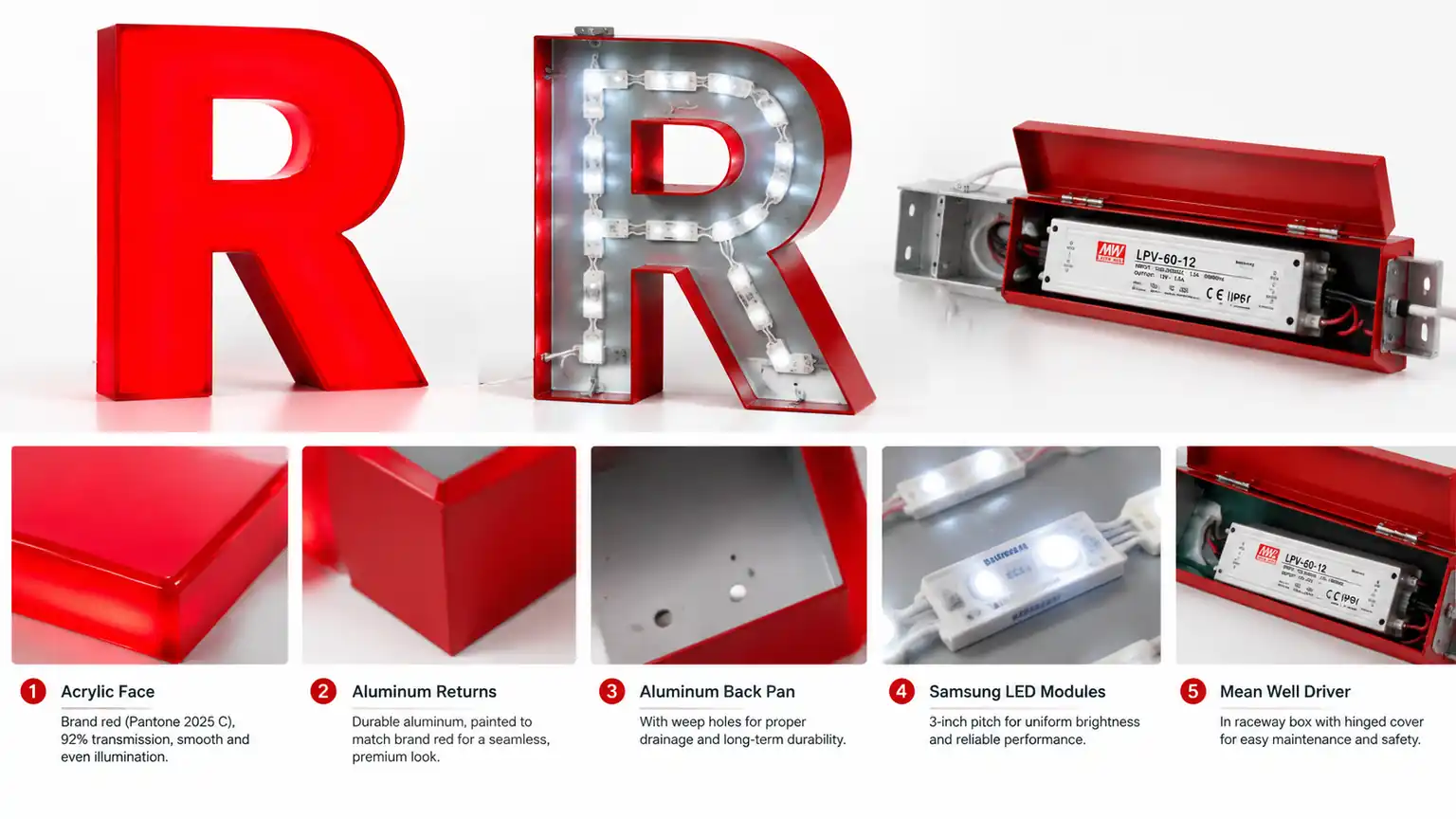
Face-lit acrylic with forward LEDs and raceway mounting delivers maximum legibility at highway speeds, the simplest fabrication and the lowest cost per square foot. The raceway channel hides the power supply and keeps the facade clean, which satisfies brand standards that demand identical signage across 50+ locations. Every sign is UL/ETL labeled, wind-load engineered and permit-ready — a compliance package you can replicate at each property.
Best for select-service brands, extended-stay and limited-service chains where scalability and brand compliance drive the spec. A neutral sans-serif face keeps the look consistent even as property names change. A side-by-side look at backlit vs face-lit channel letters makes the trade-offs clear, and the front-lit channel letters line is the workhorse for rollout.
Infinity Mirror — Lifestyle Resort, Rooftop Bar, Wedding Venue
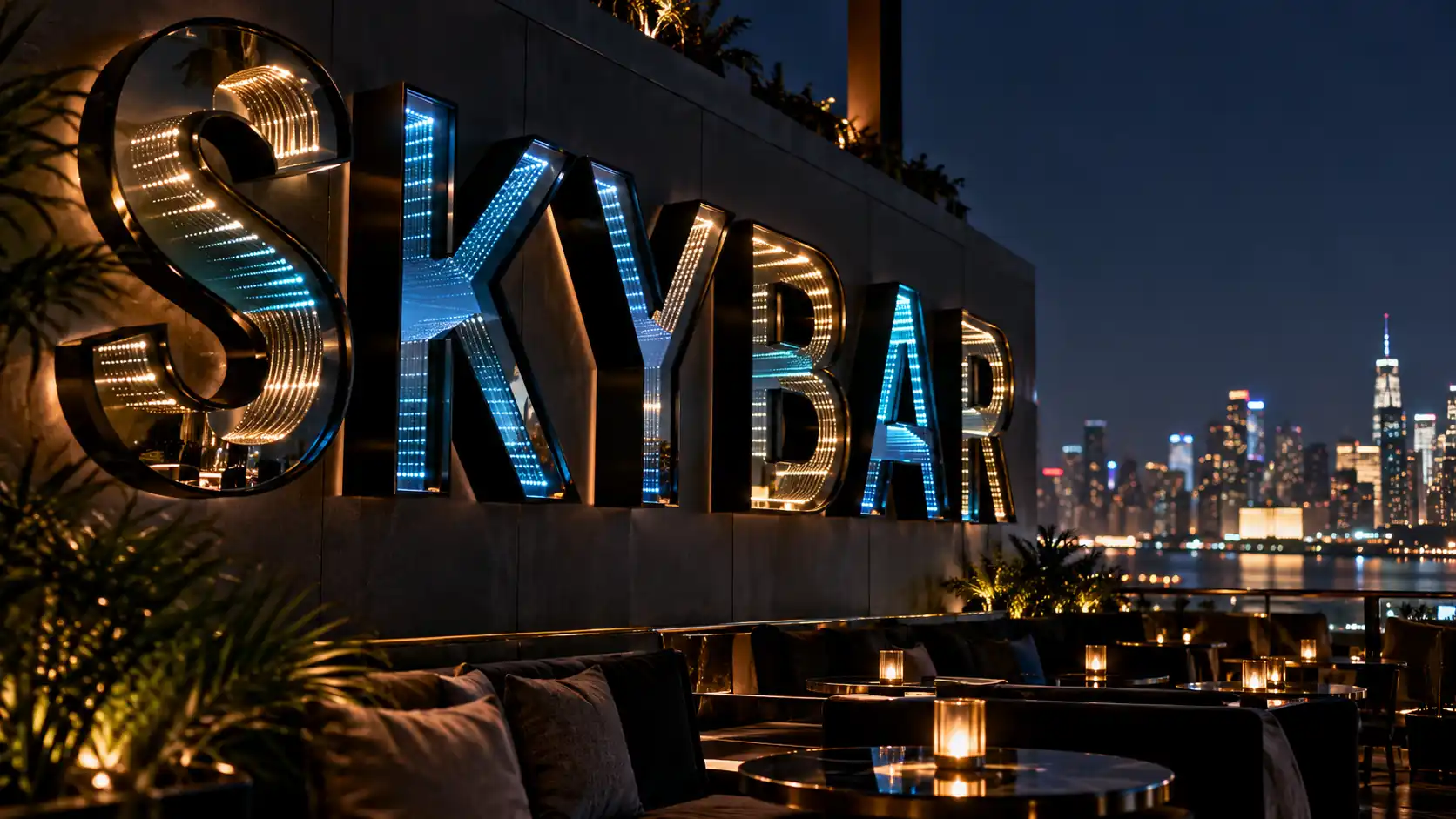
A front mirror, rear LED array and a partially reflective rear panel create the infinite-depth illusion. In daylight the faces read as clean, premium metallic — mirror, brushed stainless, black chrome or rose gold — so the sign still works as an architectural element when it is off. After dark it becomes a hypnotic tunnel of light: a wedding photo backdrop, a social media magnet and a destination marker all at once. The sign literally becomes content that guests photograph and post.
Best for lifestyle resorts, rooftop bars, cocktail lounges and wedding/event venues where “wow” factor drives bookings and organic reach. The option to add tunable RGB edge lighting lets the same sign change color for ceremonies, holidays and brand campaigns. Discover the infinity mirror letters line.
Matching Style to Property Tier & Concept
The right line follows the property’s tier and concept. Luxury wants presence from every angle; boutique wants warmth; chains want consistency; lifestyle wants spectacle. Use this as the first filter before you pick a finish or a font.
| Property Type | Best Line | Why |
|---|---|---|
| Luxury resort / 5-star | Face-halo | Prestige from every angle, day & night |
| Boutique hotel / historic inn | Halo-lit script | Architectural harmony, warm welcome |
| B&B / homestay | Halo-lit or face-halo | Residential scale, neighbor-friendly |
| Select-service / chain | Front-lit raceway | Brand standards, multi-site rollout |
| Lifestyle resort + rooftop | Infinity mirror | Social magnet, wedding photo backdrop |
| Wedding venue / event barn | Face-halo + infinity | Ceremony backdrop + reception glow |
When in doubt, walk your own approach path and ask which style a stranger would photograph first. If the answer is “the glowing sign,” you want the line with the strongest night performance. For inspiration by property type, the hotel, B&B / homestay and travel industry galleries show real installs at each tier.
Hospitality-Specific Code & Brand Standards
Brand book compliance. We build to your spec: exact Pantone or color bin, licensed font, fixed cap height and protected clear space. For portfolios we reserve a master color bin so every property glows the same hue — consistency across 50+ locations is what turns individual signs into recognizable brand equity.
Permits and ADA. No protrusion greater than 4″ on accessible routes (flush mount preferred). We engineer standoff depth and raceway depth to stay compliant. Sign permits vary by municipality — the guide to sign permits covers the US process and what inspectors actually check. Sizing against your setback and viewing distance is the next step, detailed in the channel letter size guide.
Historic district and landmark work. In preservation districts halo-lit is often the only path — no surface penetrations, no hard glare. We have secured approvals in Charleston, Savannah, New Orleans, San Francisco and Boston’s Beacon Hill, plus dozens of Main Street programs, typically through the same raceway and Z-clip methods that keep the facade reversible.
Certification and electrical. Every sign ships UL/ETL listed, wired to NEC Article 600, with local wind-load and seismic calcs where applicable. We file the UL documentation and engineer coastal and high-rise wind loads so your sign passes inspection the first time. A clean electrical and certification package also keeps insurance and property-management compliance simple — this is one reason a well-prepared logo and spec shortens the whole project timeline.
Sizing for Hospitality Frontages
Cap height follows the viewing distance. The working rule is one inch of cap height for every two to three feet of typical viewing distance. Flagship and destination properties usually need 36–48″ cap height with a 60–100 ft setback so the brand reads from the highway and the lot. Boutique hotels and B&Bs sit closer to the residential eye line — 18–24″ cap height with a residential setback is neighbor-friendly and still legible from the walk-in approach.
Blade signs are mandatory on any secondary facade, porte-cochere or valet drop-off where the main sign is out of sight. A blade sign gives perpendicular visibility for drive-up guests circling the property. Think of the full wayfinding family as one system: channel letters on the main facade, a blade sign at the drop-off, and directional totems guiding the driveway to the lobby.
Multi-line stacks are common in hospitality. A property might carry “GRAND HOTEL” at 42″ with “EST. 1924″ at 18” beneath it. Use golden-ratio spacing (about 0.618 × the primary cap height) between lines and engineer kerning per font so the stack reads as one composed unit, not two separate signs. The size guide walks through cap-height math and setback for each tier.
Color Temperature for Guest Experience
Color temperature is a design decision with a measurable effect on how a property feels — and on guest sleep, since frontage glow can reach the window. Choose the temperature the way you choose the lobby lighting: to match the brand and the stay.
- 2700 K–3000 K — luxury, boutique and B&B. Warm, welcoming and sleep-friendly; aligned with circadian patterns so the glow is inviting without being harsh at night.
- 3500 K — select-service and business travel. Clean and alert, professional but not cold — the “well-run” signal that chains rely on.
- Face-halo pairing — a 3000 K face with a 2700 K halo creates subtle depth perception; the warm halo reads as “glow” while the cooler face stays legible.
- Infinity mirror — a 3000 K core with a tunable RGB edge. The core stays brand-consistent while the edge program-changes for weddings, holidays and campaigns.
The through-line is consistency: a guest who stays at your Miami flagship and then sees the same 3000 K face-halo glow in your Aspen boutique instantly knows they are in the right place. That repeatability across a portfolio is brand equity in physical form.
Mounting for Hospitality Structures
Hotels and resorts sit on a wider range of facade materials than any other vertical, so mounting method is as important as the light design. Get this wrong and you risk a rejected permit, a voided facade warranty or a sign that fails a decade into its life. The right method is chosen from the substrate, the building’s age and the local code — not from what is cheapest to bolt on.
Masonry, stone and stucco. Flush mounting with threaded rod and structural epoxy anchor is the default. It is clean, structural and works on most brick, stone and CMU frontages. Set the rods into sound substrate and torque to spec.
EIFS and modern facades. Use a raceway (no penetration) or a Z-clip system. This keeps the building envelope sealed — landlord-friendly and warranty-protected — which matters on newer properties with manufacturer facade warranties that void on penetrations.
Historic brick. Through-bolt with a compression washer, approved by the preservation board. Never adhesive-only: thermal cycling through seasons will fail any adhesive mount on masonry. Reversible, mechanically fastened methods are what historic commissions will sign off.
Rooftop and canopy. Engineered wind load per ASCE 7, 316 stainless hardware, and lightning protection where the sign is the highest point on the roof. We stamp the calculations so the structural engineer and the inspector both have what they need.
Valet and porte-cochere. A second face-halo set aimed at the drive-up view. This is a revenue-critical position: the guest sees the brand before they ever open the car door, and at a destination resort it doubles as the “you’ve arrived” moment.
Budget Ranges (Factory-Direct, 2026 USD)
These are factory-direct reference ranges at a 36″ cap height for a typical name length. Custom letterforms, premium finishes, dual arrays and tunable RGB all move the number up; simpler single-color front-lit with standard letterforms sits at the low end.
| Style | 36″ Cap Height Range | Notes |
|---|---|---|
| Face-halo | $4,500–$7,000 | Dual arrays, premium finishes |
| Halo-lit script | $2,200–$3,400 | 24″ typical for boutique |
| Front-lit raceway | $2,400–$3,600 | Scalable, brand-compliant |
| Infinity mirror | $5,500–$8,500 | Mirror finish, engineered depth, RGB option |
Multi-site rollout (10+ properties): 12–18% volume discount. MOQ one unit. Five to fifteen working days. Ships globally. The biggest cost lever before fabrication is the logo and letterform itself — clean, vector-accurate artwork avoids rework. The logo preparation guide explains exactly what a factory needs to quote and build without surprises.
Case Snapshots (Y SIGNS Portfolio)
A few representative hospitality installs, all built from our channel letter lines. Each is a live product page with finishes, sizing and the specs that went into it.
- Hotel Front-and-Back Lit Sign — luxury flagship, 42″ face-halo, 3000 K face / 2700 K halo, visible from driveway, valet and pool deck.
- B&B / Homestay Halo-Lit Channel Letters — historic inn, 20″ script on brushed stainless, 2700 K, flush raceway for a residential neighborhood.
- Hotel Infinity Mirror Letters — lifestyle resort rooftop, 36″ infinity, 3000 K core with tunable RGB edge for events.
- Travel Agency Front-Lit Channel Letters — select-service, 30″ raceway, 3500 K, a clean, brand-compliant look built for rollout.
- Wedding & Photography Halo-Lit Channel Letters — event venue, 24″ halo-lit, the warm glow that doubles as a ceremony and reception backdrop.
For more by property type, see the hotel and wedding & photography galleries, plus leisure & club venues where infinity mirror and face-halo features earn their keep.
Rollout Playbook: From One Flagship to Fifty
Scaling a sign program across a hospitality portfolio is a systems problem, not fifty individual projects. Here is how we run it.
- Master spec packet. Shop drawings, ASCE 7 wind calculations, the UL/ETL file, reserved color bins and a property-level installation guide — one document set that every site builds from. This is the backbone of multi-location standardization.
- Regional install partners. We coordinate vetted installers near each property; you approve. They build to the master spec so a sign in Denver matches one in Austin down to the color bin.
- QA at every site. A first-article inspection on the flagship, then a photo report per property — face finish, halo depth, color temperature and mounting — checked against the spec before sign-off.
- Maintenance by design. Five-year LED warranty and remote-accessible drivers, so a driver swap is a fifteen-minute job, no bucket truck and no full sign rebuild. Downtime at a valet-facing sign is lost revenue; this design keeps it near zero.
Ready to scale your hospitality brand? Browse all channel letter lines or request a portfolio review — we will return a multi-site rollout plan and a flagship mockup within 48 hours.