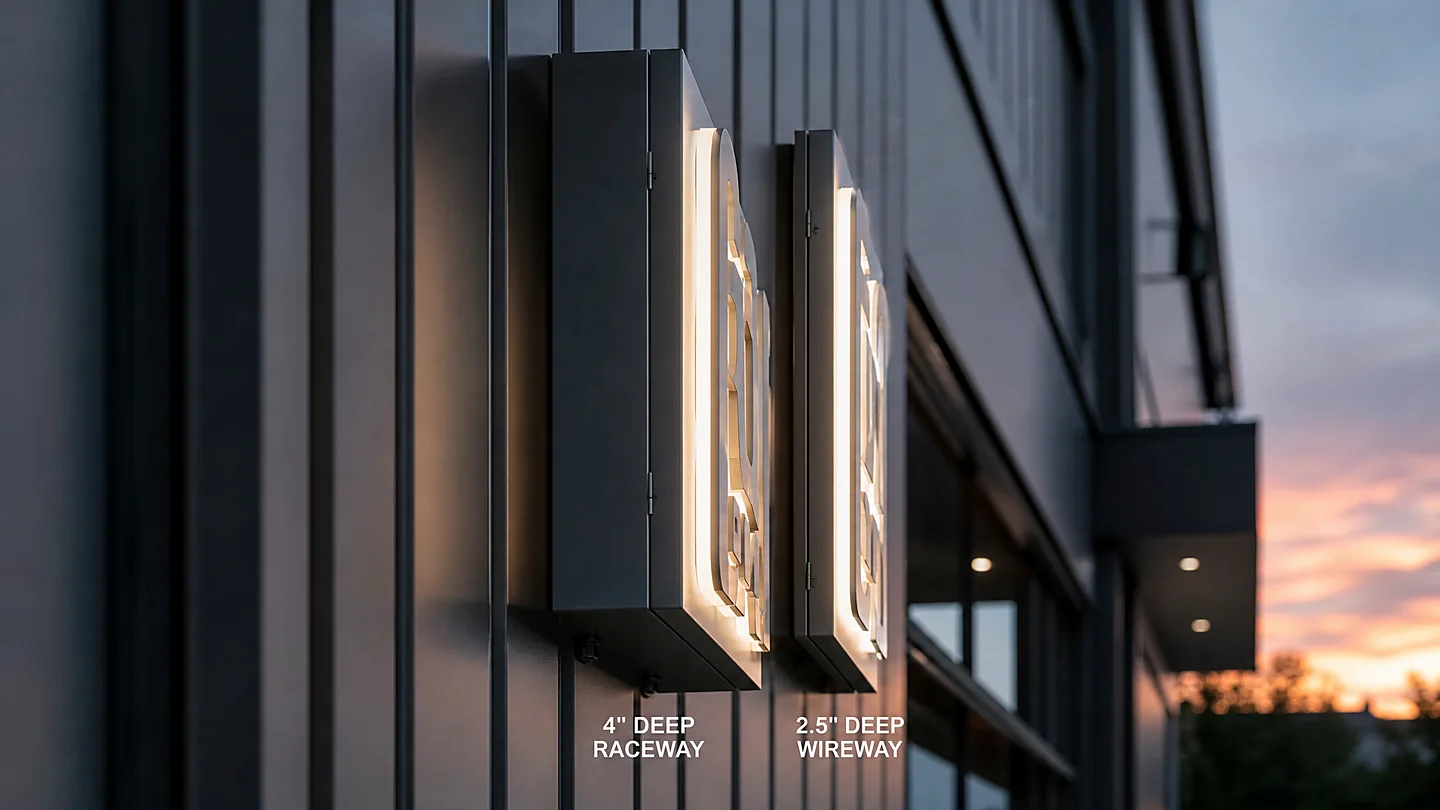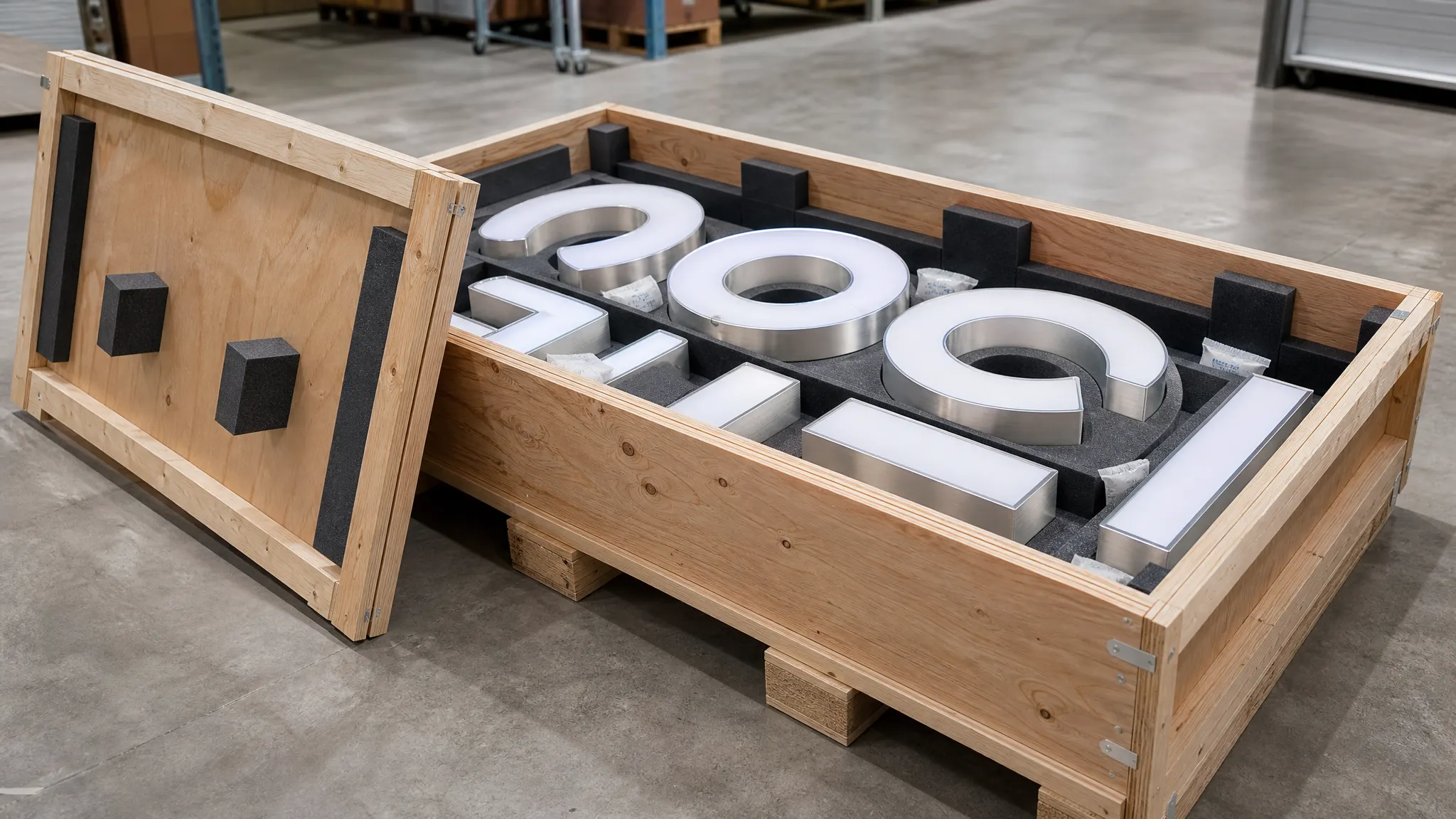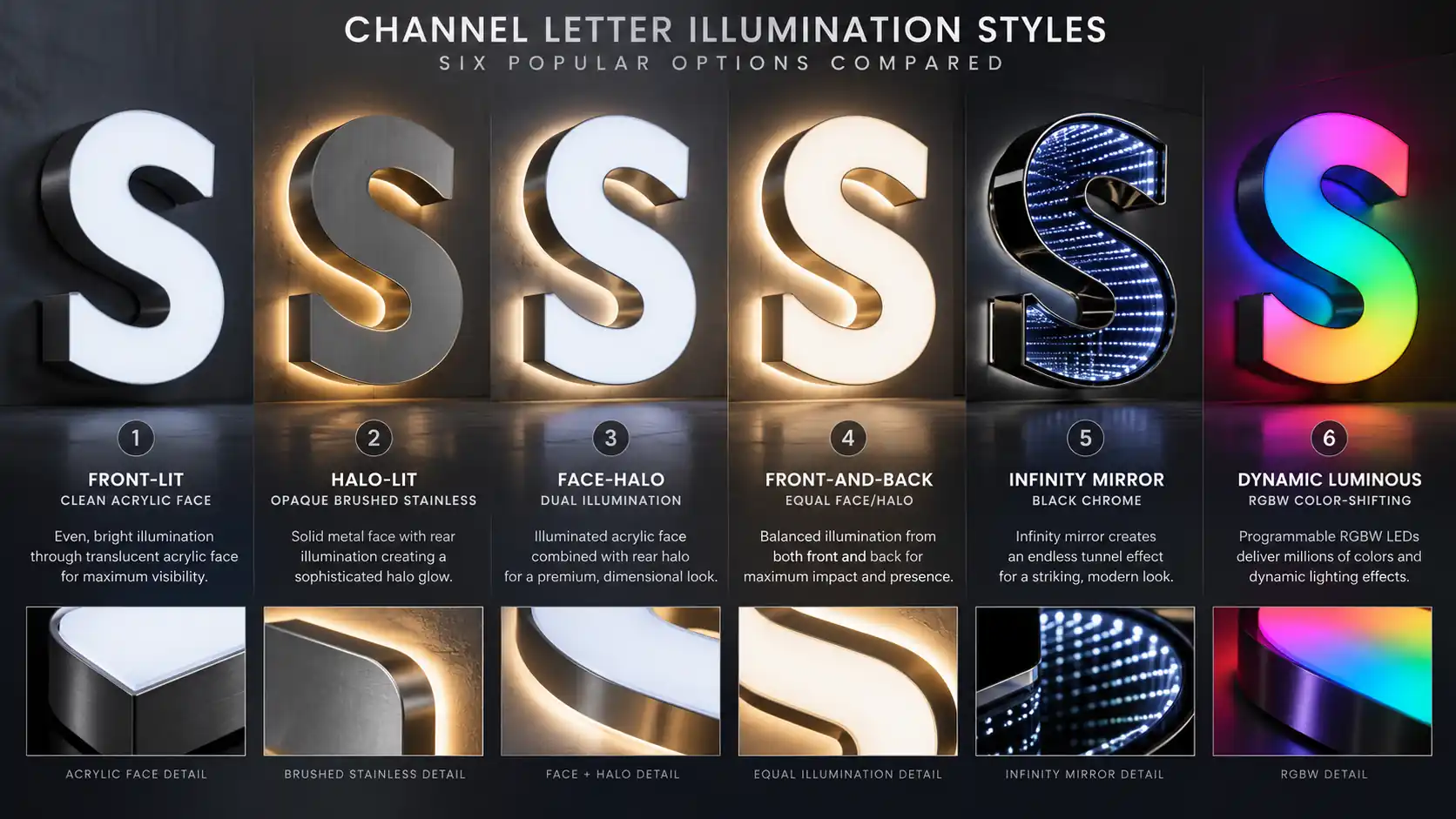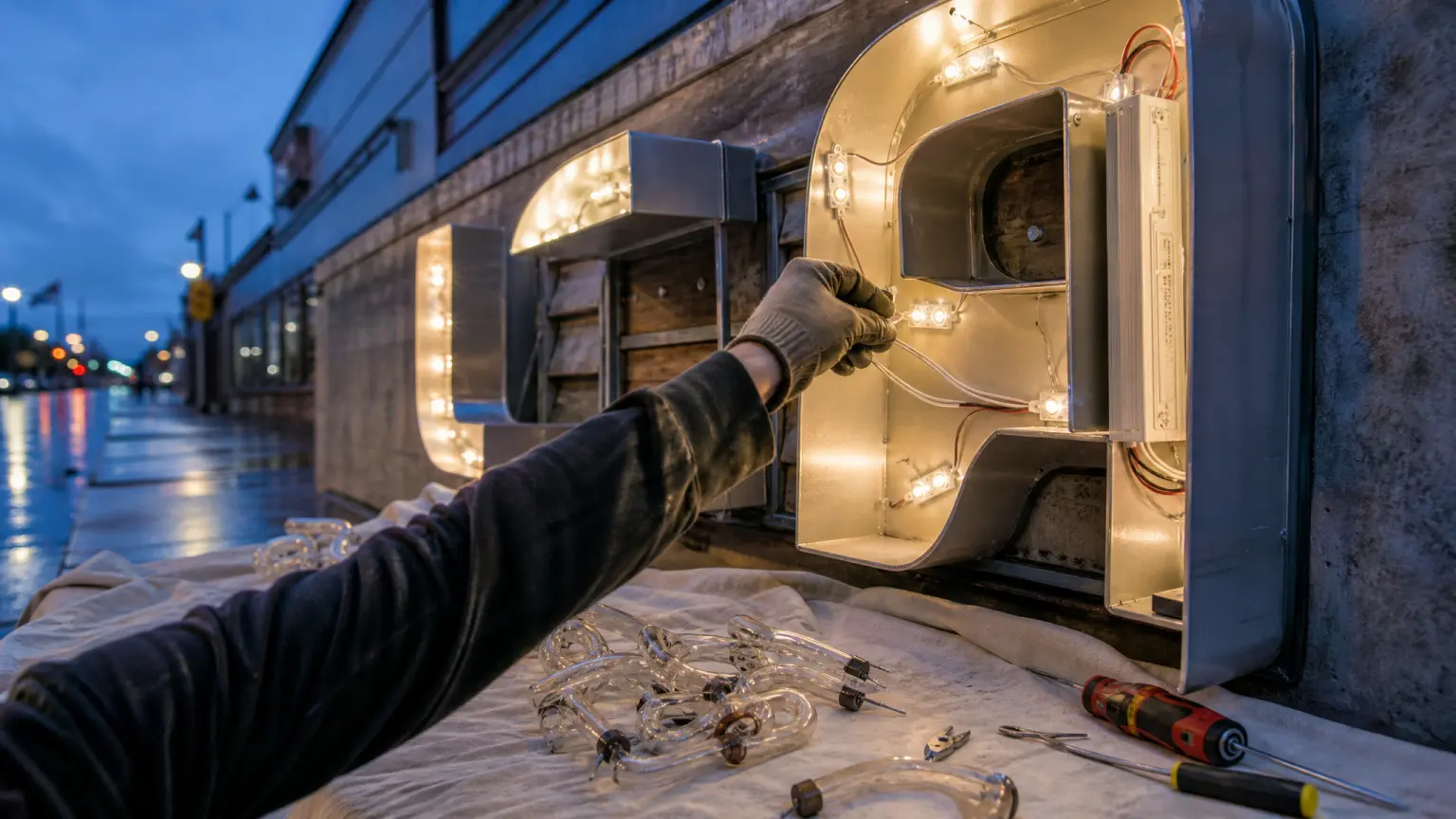
Strip a channel letter down and you find the same thing every time: an aluminum return, a face, a back pan, an LED array, a driver, and a mounting system. The skeleton is commodity sheet-metal work. The decision that turns that skeleton into a brand asset — or into a six-figure mistake across forty locations — is the illumination line. Where the light comes from changes the price, the permit outcome, the maintenance schedule, and what a customer understands about your business before they read a single word of your name.
This is the selector page for that decision: six lines, one decision tree, three head-to-head matrices, an industry match table, a budget framework, and the upgrade paths that keep a sign from becoming obsolete. Choosing a channel letter type is, in practice, choosing where the light comes from — and that choice is expensive to reverse.
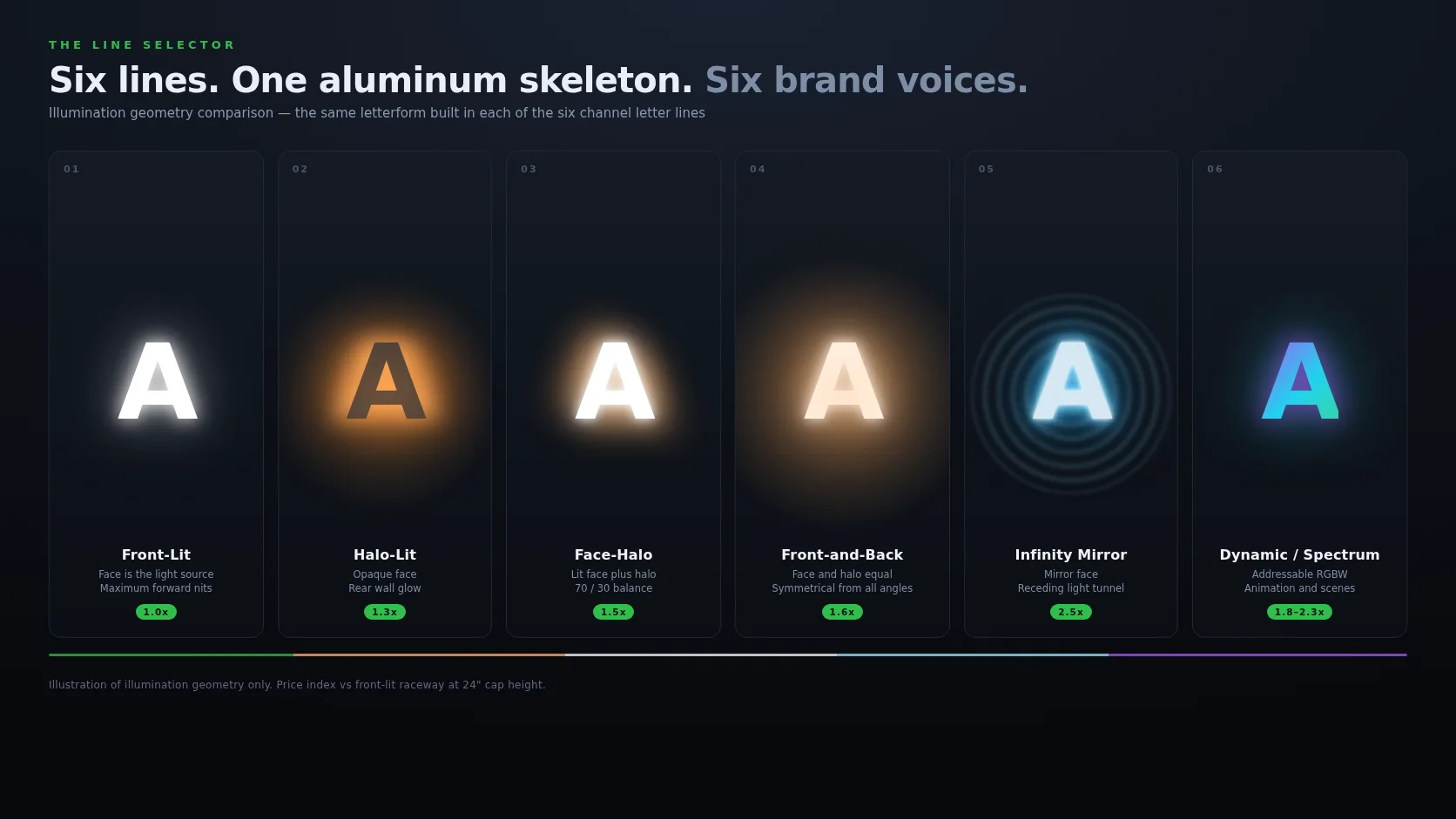
One Sign, Six Personalities — The Line Selector Framework
Every one of the six lines starts with the same fabrication: 0.040" to 0.063" aluminum returns, a 3" to 6" trim depth, a welded or riveted back pan, and a 12V or 24V LED module layout. What changes is the geometry of the light. That geometry is the whole personality of the sign.
Forward light broadcasts. It says here I am, read me from the far lane. Rear light whispers. It says look at the wall, the letter is floating. Light that passes through the face and spills behind it at the same time says both, and the ratio between the two is a positioning decision, not a technical one. An infinity mirror turns the letter into an object you photograph. A dynamic array turns the letter into a channel you can change by the hour.
Three lenses organize the choice, and they should be used in this order:
- Decision tree (the job). Is the sign required to be read at 50 mph, satisfy a historic commission, anchor a flagship, or generate bookings?
- Comparison matrix (the trade-offs). Once two lines survive, compare day readability, night character, permit risk, and maintenance surface.
- ROI lens (the money). Cost per year of visible brand presence — energy, service visits, and the revenue the sign influences — beats price per letter.
Two practical notes before you start. The permit always wins: in a historic district or design-review corridor the approved illumination method is a constraint, not a preference, so check zoning before you fall in love with a rendering. And one question halves the field immediately — does the sign have to work in daylight? If yes, an opaque face is out, which pushes you toward front-lit, face-halo, or a mirrored face.
The Six Lines at a Glance
The table below is the entire selector compressed to one screen. The price index uses front-lit on a raceway at 24" cap height as 1.0x; every other line is expressed relative to that baseline, because relative cost travels better across markets than absolute dollars do.
| Line | Core Vibe | Day Look | Night Look | Price Index* | Best For |
|---|---|---|---|---|---|
| Front-Lit | Workhorse, reliable, readable | Clean acrylic face | Bright, even, 100% forward | 1.0x (base) | Chains, drive-thru, high-visibility corridors, budget-led rollouts |
| Halo-Lit | Craft, warmth, premium restraint | Opaque face (brushed or painted) | Floating rear glow, dimensional | 1.3x | Boutique retail, historic districts, wellness, B&B |
| Face-Halo | Prestige, 360° visibility | Translucent face | Face glow plus halo depth | 1.5x | Hotels, medical, flagship stores, historic adaptive reuse |
| Front-and-Back | Architectural symmetry | Translucent face | Equal face and halo balance | 1.6x | Landmarks, institutions, plazas, freestanding monuments |
| Infinity Mirror | Spectacle, depth, social currency | Mirror finish (stainless, black chrome, rose gold) | Infinite tunnel of light | 2.5x | Rooftops, weddings and events, nightlife, flagship statements |
| Dynamic / Spectrum | Revenue, adaptability, alive | Clean face, static when idle | Color zones, animation, beat-sync | 1.8–2.3x | QSR, fitness, nightclubs, hotels, retail with campaign cycles |
*Price index versus front-lit raceway-mounted letters at 24" cap height, factory-direct, excluding freight, permits, and installation. MOQ is 1 on all six lines; volume breaks start at five units.
Each line also has a full buyer’s guide: front-lit channel letters, face-halo and front-and-back, infinity mirror, and dynamic luminous and spectrum glow. Spec sheets and per-letter pricing live on the product pages for front-lit letters, halo-lit letters, front-and-back letters, infinity mirror letters, and spectrum glow letters.
Decision Tree — Start Here
Work top to bottom and stop at the first branch that describes your primary constraint. If two branches apply, take the higher one: a historic district with a drive-thru window is still a historic-district sign, and the commission will treat it that way.
START: What is the PRIMARY job of this sign?

├─ HIGHWAY / DRIVE-THRU / 50+ MPH readability
│   └─ Front-Lit (raceway) — maximum nits per dollar
│
├─ HISTORIC DISTRICT / NEIGHBOR-SENSITIVE / ARCHITECT-DRIVEN
│   ├─ Halo-Lit (often the only approved method) — warm, subtle
│   └─ Face-Halo (if face glow is permitted) — controlled + warm
│
├─ PRESTIGE / FLAGSHIP / MULTI-ANGLE VISIBILITY
│   ├─ Face-Halo — face readable, halo warm, three viewing vectors
│   └─ Front-and-Back — pure symmetry, equal from every angle
│
├─ SOCIAL / EVENT / WEDDING / PHOTO-DRIVEN REVENUE
│   └─ Infinity Mirror — ceremony backdrop, press, organic reach
│
├─ MENU SYNC / CLASS STATUS / BEAT SYNC / CAMPAIGN COLORS
│   ├─ Dynamic Luminous — full animation, API, DMX, POS integration
│   ├─ Spectrum Glow — color zones, scheduled scenes
│   └─ Neon-Style — curves, scripts, neon aesthetic
│
└─ BUDGET-CONSCIOUS / SCALABLE / CONSISTENT
    └─ Front-Lit — still roughly 70% of the market for a reason
Highway and drive-thru. Front-lit wins on physics: the face is the light source, so nearly all lumens leave the letter toward the driver and none are wasted washing a wall. At 24" cap height and 50–70 mph approach speeds, a 5,000–6,500K front-lit face reads at roughly twice the distance of a halo-lit letter, because the readable element is the letterform rather than a silhouette.
Historic and neighbor-sensitive. Halo-lit is frequently the only illuminated method a historic commission will approve, because the source is concealed and the visible sign is a matte object rather than a glowing panel. Where face illumination is allowed but muted, face-halo at roughly 30–40% of a standard front-lit face satisfies the "illuminated but not garish" language most design guidelines use.
Prestige and flagship. Face-halo is the default for hospitality and healthcare because it reads from three vectors: directly in front, obliquely down the street, and in a window reflection. Front-and-back is the more architectural choice — identical from every angle, commonly specified for freestanding monuments and civic work.
Social and event revenue. Infinity mirror is a different category wearing a channel letter’s shape. Its job is to be photographed: if bookings, press, or user-generated content are part of the revenue model, the premium is justified by the content rather than by legibility.
Operational flexibility and scale. Dynamic and spectrum lines are bought when the sign has a job beyond identification: daypart color, "open now" status, beat-sync, seasonal palettes. If the sign will never change, this branch is an expensive answer to a question you did not ask. And when the priority is a repeatable rollout, front-lit wins on more than price — one array, one driver, one service procedure, and the widest pool of qualified installers in every market.
Head-to-Head Comparison Tables
Once the tree leaves two finalists, compare them on the four criteria that change a purchase order: daytime performance, night character, permit risk, and cost of ownership.
A. Front-Lit vs Halo-Lit
| Factor | Front-Lit | Halo-Lit |
|---|---|---|
| Day readability | ★★★★★ | ★★★☆☆ (opaque face) |
| Night warmth | ★★★☆☆ | ★★★★★ |
| Historic approval | Often denied | Usually the only approved option |
| Cost (24" cap) | $1,200–$1,800 | $1,600–$2,400 |
| Maintenance surface | One array, face removable | One array, face sealed |
| Failure signature | Visible dead segment | Dim halo patch, easy to miss |
The trade is legibility versus character, and character costs about 30–40%. Halo-lit carries a maintenance advantage — the face is opaque and sealed, so UV and moisture matter less and the array sits in a protected cavity. The cost is diagnostic: a failing module shows up as a soft dim patch rather than an obvious dark letter, so halo signs need an annual night inspection.
B. Face-Halo vs Front-and-Back
| Factor | Face-Halo | Front-and-Back |
|---|---|---|
| Face dominance | About 70% face / 30% halo | About 50% / 50% |
| Brand readability | ★★★★★ | ★★★★☆ |
| Halo warmth | ★★★★☆ | ★★★★★ |
| Historic approval | Often approved | Case-by-case |
| Cost (30" cap) | $3,000–$4,500 | $3,500–$5,000 |
| Best viewing geometry | Front and oblique street view | All angles, freestanding |
Face-halo is the readability-first dual line: the face is the primary source and the rear array is tuned lower, so the halo frames rather than competes. Front-and-back pushes both arrays to comparable output, which looks balanced on a monument and slightly busy on a narrow storefront. Both need two arrays, two driver channels, and a deeper return — 5" to 6" versus 3" to 4" for single lines — which is why dual-line signs cannot always be retrofitted into a shallow cabinet.
For a historic commission, face-halo is the easier approval: the halo dials down and the face can be specified warm at 2700–3000K. Front-and-back is harder to defend, because at equal output the wall wash is roughly twice as bright as a conventional halo sign and reviewers read that as glare.
C. Infinity Mirror vs Dynamic
| Factor | Infinity Mirror | Dynamic Luminous |
|---|---|---|
| Static brand presence | ★★★★★ (mirror face) | ★★★★★ (fixed white) |
| Animation | RGBW edge effect only | Full RGBW per module, pixel-mapped |
| Revenue mechanism | Event bookings, photography, press | Menu sync, class status, campaign color |
| Mounting options | Flush only (sealed cavity) | Raceway, flush, or wireway |
| Cost (36" cap) | $5,500–$8,500 | $5,500–$8,000 |
| Service model | Mirror and film care, no re-polishing | Controller, data, firmware updates |
These two are shortlisted together because they share a price band, but they solve opposite problems. Infinity mirror is a static line with a spectacular face — by day a mirror-finish dimensional letter, by night a tunnel. Dynamic luminous is a programmable line with a conventional face — by day clean and quiet, by night a screen made of letters.
Choose infinity mirror when the value is in being photographed and remembered, and accept that it must be flush-mounted in a sealed cabinet so the cavity stays clean and dry. Choose dynamic when the value is in changing the message: daypart menus, class-status color, a bar that shifts palette with the DJ. Dynamic carries an operating cost the infinity line does not — a controller, a content workflow, and someone on staff who owns it.
Industry × Line — Quick Match Matrix
Vertical norms encode what customers in a category already expect to see, and where a sign either reassures or confuses. Use this as a starting hypothesis, then confirm against the decision tree.
| Industry | 1st Choice | 2nd Choice | Avoid |
|---|---|---|---|
| Restaurant / coffee | Face-halo / halo | Front-lit | Infinity (budget and glare) |
| Hotel / B&B | Face-halo | Halo / infinity (rooftop) | Front-lit on a flagship |
| Medical / dental | Face-halo (3500–4000K) | Front-lit (3500K) | Dynamic |
| Retail flagship | Face-halo / infinity | Dynamic | Plain halo (low visibility) |
| Fitness gym | Front-lit (4500–5000K) | Dynamic (class status) | Halo |
| Nightclub / bar | Dynamic / infinity | Face-halo | Front-lit (wrong register) |
| QSR / drive-thru | Front-lit | Face-halo | Infinity |
| Gas / auto service | Front-lit (5000–6500K) | — | Halo / infinity |
| Wellness / yoga | Halo (2700–3000K) | Face-halo | Dynamic (wrong register) |
Healthcare is the clearest case. A patient forms a competence judgment in about three seconds, and face-halo at 3500–4000K delivers exactly the signals that read as clinical: even, neutral, no color shift, legible from a car. Dynamic lighting there reads as a bar rather than a practice, which is why it lands in the avoid column despite being technically impressive.
Restaurants split by price point rather than cuisine. A café or neighborhood restaurant does well with halo or face-halo because warm, low-glare light signals craft; a QSR on a commercial strip needs front-lit to win the impulse decision at 40 mph. Nightlife is the one vertical where premium lines are almost always correct. The restaurant guide and the bar and nightclub guide cover both in depth, and coffee and beauty and wellness sit at the warm end of the same spectrum.
Budget Decision Framework
Budget conversations go wrong when a buyer compares a 24" front-lit letter to a 36" infinity mirror letter and concludes the premium line is "three times the price." Cap height, depth, and mount drive cost more than the line does. Compare like for like, then apply the framework below.
| Budget per letter | Recommended line | What you are buying |
|---|---|---|
| Under $2,000 | Front-lit | Maximum visible hours per dollar; easiest service network |
| $2,000–$3,500 | Face-halo / halo | Prestige and warmth without a second controller layer |
| $3,500–$6,000 | Infinity / dynamic | Differentiation that produces content or operating flexibility |
| $6,000+ | Infinity custom / dynamic full-show | Landmark status, bespoke geometry, pixel-mapped animation |
Five variables move the number more than the illumination line does:
- Cap height. Cost scales closer to the square of height than linearly, because face area and return length both grow.
- Trim depth. Going from 3" to 6" adds aluminum and LED standoff, and can force a larger crate and higher freight.
- Face material. Standard acrylic is the baseline; polycarbonate, impact-modified acrylic, and specialty diffusers add 15–40%.
- Array count and control. A second array means a second driver channel, more wiring, and a larger junction box.
- Mount and access. Raceway is cheapest and most serviceable; flush requires templates and often a lift.
Where not to cut: the driver, the UL/ETL listed power supply, the return gauge, and the warranty terms. Those four determine whether a sign is still uniform in year five. Saving $180 on a driver and losing a letter each July costs more than the entire premium line would have; listing requirements are covered in the UL and ETL guide. Freight is the other silent cost — see shipping, crating and receiving channel letters.
Total cost of ownership is mostly service, not energy. A 24" front-lit letter draws roughly 12–18W, and over ten years the energy gap between lines is trivial next to the difference in service visits — which is why simpler lines stay rational for portfolios of twenty or more locations.
Multi-Line Strategies (Real Portfolios)
The most common mistake in multi-location branding is standardizing on one line for every tier. A hotel group that puts infinity mirror letters on a roadside select-service property has overpaid; a group that puts front-lit raceway letters on its flagship has under-delivered. Line tiering solves both problems.
Hotel portfolio
Flagship and full-service properties carry face-halo — the line that matches the rate guests pay and survives a brand standards review. Select-service and airport properties use front-lit on a raceway, where the job is arrival legibility from a drop-off lane. Rooftop bars inside the portfolio use infinity mirror as an amenity sign: it markets the venue, not the room rate. The hospitality signage guide covers the tier structure.
Restaurant chain
Flagship dining rooms use face-halo; drive-thru and pickup windows use front-lit for legibility under canopy lighting; patios and bar entrances use dynamic accents, usually a single short word rather than the full wordmark, so animation never fights the primary sign. Brand recognition stays consistent while the highest-margin channel stays ruthlessly legible.
Fitness brand
Big-box gyms use front-lit at 4500–5000K because the audience is deciding at speed in daylight. Boutique studios use dynamic to display class status and color-code programming. Yoga and recovery studios use halo at 2700–3000K, where the sign is a mood signal rather than wayfinding. The fitness studio guide covers class-status integration in detail.
Retail flagship
The flagship carries infinity mirror or face-halo; mall entrances and secondary egresses use face-halo at lower cost; seasonal messaging uses dynamic. Retail is where dynamic earns its premium most reliably, because campaign color cycles are already part of the marketing calendar — the sign joins a workflow that exists.
Across all four patterns the discipline is the same: one primary line per tier, one secondary line for supporting signage, and a documented rule for which physical conditions force an exception. Without it, every new location becomes a design debate. The multi-location standardization guide covers the spec-sheet structure.
Future-Proofing: Upgrade Paths
Signs outlive marketing plans. A channel letter set is replaced every 10–15 years, but brand positioning changes on a 3–5 year cycle. Designing for the upgrade is cheaper than replacing the sign.
| From | To | What changes | Typical lead time |
|---|---|---|---|
| Front-lit | Face-halo | Add rear array and driver channel; deepen return | 3–5 days, or field retrofit if depth allows |
| Face-halo | Dynamic halo | Swap rear array to RGBW, add controller | 2–4 days plus programming |
| Front-lit | Dynamic | New face and RGBW modules; usually a new letter set | 7–12 days |
| Halo-lit | Face-halo | Translucent face and front array replace opaque face | 5–8 days |
| Static | Infinity mirror | New cabinet with mirror cavity; not a field retrofit | 10–15 days |
Five design decisions keep those upgrades possible later:
- Specify a 2.5" minimum return even on single-line letters. A rear array needs standoff clearance, and 2.5" keeps the halo option open without changing the face.
- Oversize the junction box by one circuit. A dual line needs a second channel; a shallow box turns a three-day upgrade into a wall-opening project.
- Leave 20% driver headroom. A driver at 95% utilization has no room for a second array.
- Run spare conductors in the raceway. Data lines for a future controller cost almost nothing at build time and a great deal afterward.
- Archive the wiring diagram. An upgrade is only as fast as the next technician’s understanding of what is behind the letter.
If the existing sign is already at end of life, replacing usually beats upgrading; the retrofit versus new-build guide covers the break-even logic, and the raceway, flush mount and wireway guide compares mounting choices for both paths.
Specifying in Your Brand Standards
Once the line is chosen, write it in a form a fabricator can build from and a landlord can approve. Six items belong in the standard:
- Primary line per tier. Name the line and the tier — flagship, standard, drive-thru, rooftop — rather than leaving line choice to the local architect.
- CCT, CRI and SDCM per line. 3000K, CRI 80+, 3-step MacAdam ellipse is the practical consistency target; higher CRI pays off when the face carries a saturated brand color.
- Face material and finish. Acrylic grade, thickness, diffusion level, and the Pantone or RAL reference converted to a light-transmitting match.
- Trim depth and return gauge. These govern visual weight and whether the sign can be upgraded later.
- Mount type. Raceway as default; flush where the standard requires a clean facade or the jurisdiction requires concealment.
- Upgrade clause. One sentence stating the return must accommodate a future rear array — free at order time, valuable for a decade.
A spec clause that has survived real procurement looks like this:
Illumination line: FACE-HALO (dual array)
Face: 3/16" acrylic, 7328 diffusion, Pantone 2965C matched
CCT: face 4000K / halo 2700K, CRI 80+, 3-step SDCM
Return: 0.063" aluminum, 5.5" depth (min 2.5" clear behind rear array)
Mount: flush, concealed raceway, UL-listed Class 2 driver
Warranty: 5 years LED / 3 years finish / 1 year labor
Upgrade: rear cavity and junction box sized for RGBW retrofit
Two supporting specs are frequently forgotten and always cost money later. Define the photometric target — most brands specify face luminance rather than wattage, because wattage says nothing about how the sign looks next to a competitor. And specify color temperature across the portfolio, not per location; a 3000K halo next to a 4000K halo in the same center reads as two different companies. The LED color temperature guide covers binning and SDCM in practical terms.
Your Next Step: The 15-Minute Spec Call
You do not need a finished design to make this decision. You need a logo, a photograph of the storefront, and an honest answer about the primary job of the sign. If you are still trying to choose a channel letter type from finish samples alone, start with the storefront photographs — the line usually becomes obvious there.
Send us:
- Vector logo (AI, EPS, PDF or SVG) with exact brand colors
- Two or three storefront photographs, including one at night if the building already has signage
- Brand Pantone references, or the target look if the brand is new
- Target color temperature, if your brand standards specify one
- City and state, so we can flag the permit path before design starts
We return, within one business day:
- A rendered mockup showing the same wordmark in three illumination lines
- A written recommendation tied to your decision-tree branch, with the reasoning
- Budget ranges at your cap height, factory-direct, freight excluded
- Lead times and the upgrade path if the brand is expected to evolve
No obligation, and no pressure to pick the premium line — the recommendation follows the job, not the margin. Start with the quote request form, browse the full product line, or read how to prepare your logo for a channel letter quote before you send files.